

What if the hourly home health care rate you find describes a different service from the one your family needs? In California, quotes can refer to personal assistance at home, while clinical care from a nurse or therapist may be billed by visit or another unit. That difference matters when you’re trying to build a realistic budget. When searching for “hourly home health care rates California,” start by identifying the service and how it is billed.
It’s understandable to want a clear estimate before arranging care. The right plan depends on the person’s needs, the tasks involved, and when and how often support is required. This guide explains what hourly personal care may cover, how skilled nursing and therapy billing differs, and which details to compare when reviewing an estimate. It also outlines how insurance or public programs may help, while recognizing that eligibility and coverage depend on individual circumstances.
Everest Peak Home Health Care provides hourly personal care assistance alongside scheduled clinical visits, including skilled nursing and rehabilitation therapies, in the surrounding Los Angeles area. The sections ahead will help you compare these services and plan for their different billing approaches.
Key Takeaways
- Hourly home health care rates California quotes can describe different services, so identify the care type and billing unit before comparing figures.
- Use a consistent checklist to compare tasks, staff type, schedule, minimum visit requirements, and any separately stated charges.
- Build a Los Angeles care plan by defining needs, mapping the schedule, and applying an agreed hourly fee only to billable hours under hourly billing.
- Separate hourly personal care assistance from fee-for-service nursing and therapy visits to make the budget easier to understand.
- Document care needs and consider how Everest Peak’s personal care, nursing, and therapy services may fit the plan.
Hourly home health care rates in California: what does the hourly price mean?
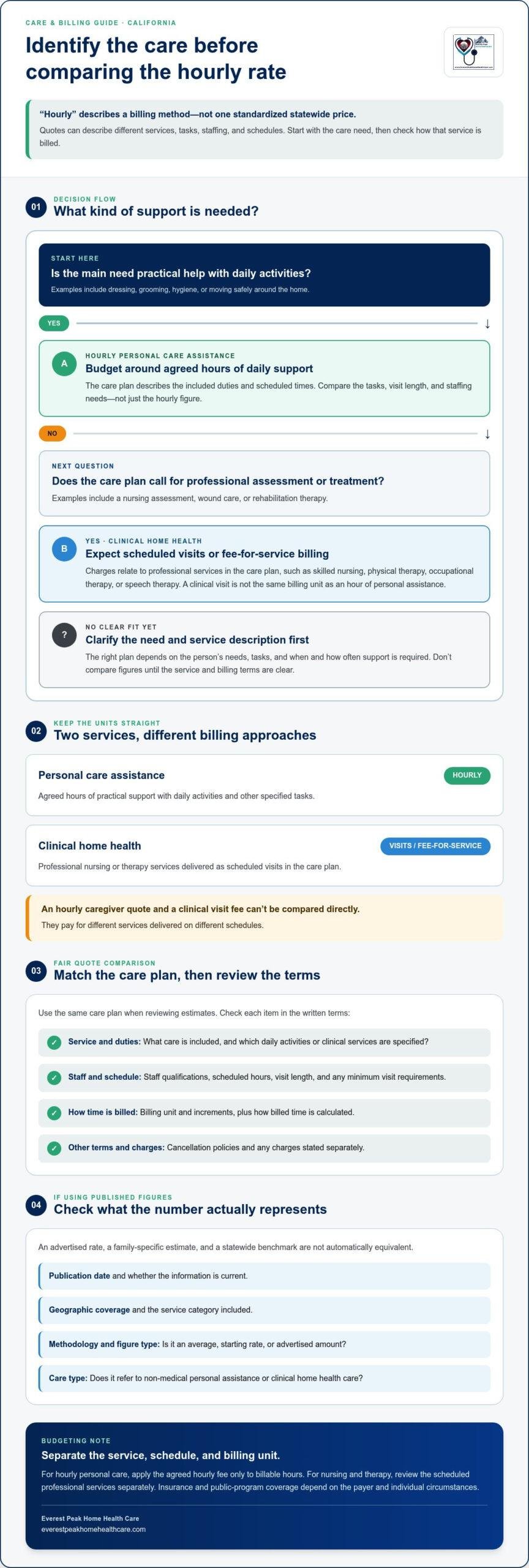
“Hourly” describes how a service is billed, not one standardized statewide price. A quote reflects a particular care arrangement, including the tasks involved, staff qualifications, scheduled hours, and how the service is organized. As a result, two amounts described as hourly home health care rates California may refer to very different kinds of support.
Start by identifying the service. Personal care assistance can support daily activities, such as getting dressed or moving safely around the home. Clinical home health services involve professional care, such as nursing assessment or therapy, and may be billed as scheduled visits rather than by the hour. Understanding the different types of home care can help clarify the distinction. For budgeting, focus on the service description and billing terms in each estimate.
What can an hourly home care quote cover?
An hourly arrangement may describe personal assistance during agreed times, with the care plan specifying which daily activities are included. Compare the duties, schedule, visit length, and staffing needs to understand what the quoted fee represents. Review the written terms for included services, billing increments, cancellation policies, and any charges stated separately. These details show what support is planned and how billed time is calculated.
Why California rate figures are difficult to compare
Figures can differ by county, service type, provider arrangement, and timing. An advertised rate describes one provider’s stated offer. A family-specific estimate reflects an individual’s needs and schedule, while a statewide benchmark summarizes data using its own definitions and methodology. These figures are not automatically equivalent, and none should be treated as a quote for clinical nursing or therapy.
If you use public data to inform a budget, check its publication date, geographic coverage, methodology, and service category. Confirm whether it concerns non-medical personal assistance or clinical home health care, and whether the figure is an average, a starting rate, or an advertised amount. Without those details, a comparison may be misleading.
Compare the same services and schedules, not rates alone. An hourly personal care schedule and a set of professional therapy visits use different billing units, so their headline figures won’t show which arrangement better fits the care need. Everest Peak Home Health Care provides hourly personal care assistance and fee-for-service clinical visits, including skilled nursing and therapy. Each approach serves a different purpose.
Hourly personal care versus clinical home health visits: why billing differs
The phrase “home health care” can refer to different kinds of support. Personal care assistance helps with daily activities, while clinical home health involves professional assessment or treatment. Because the services and billing units differ, hourly home health care rates California searches may surface figures that aren’t directly comparable.
| Care type | Common billing approach | What the charge relates to |
|---|---|---|
| Personal care assistance | Hourly | Agreed hours of support with daily activities and other specified tasks |
| Clinical home health | Scheduled visits or fee-for-service | Professional nursing or therapy services in the care plan |
A clinical visit fee relates to the professional service provided, not simply time spent offering companionship. A nurse’s assessment and a therapy session each have a clinical purpose. Neither is the same unit of care as an hour of personal assistance. Insurance coverage and payment rules vary by payer and circumstances, so don’t assume a service is covered based on its billing format. Medicare.gov offers Comparing Medicare-certified home health agencies, a resource for reviewing agency information, but it doesn’t replace checking coverage for an individual’s situation.
When hourly personal care assistance may fit
Hourly personal care may fit when a person needs practical help with grooming, hygiene, or other activities of daily living. For a useful comparison, write down the duties and scheduled hours each arrangement includes. Personal care assistance in North Hollywood is one way to learn more about this kind of support.
When a scheduled nursing or therapy visit may fit
A clinical visit may be relevant when the care plan calls for a professional service, such as a nursing assessment, wound care, or rehabilitation. These services involve distinct disciplines: skilled nursing, physical therapy, occupational therapy, and speech therapy. The appropriate service depends on the person’s needs and care plan. Its billing shouldn’t be interpreted as an hourly companionship rate.
An hourly caregiver quote and a clinical visit fee can’t be compared directly because they pay for different services delivered on different schedules. Identifying the kind of support needed is a sound first step toward a suitable plan. Families in the surrounding Los Angeles area can explore how in-home personal and clinical care may align with documented needs.
How to compare California home health care quotes fairly
A fair comparison begins with the same care plan for every estimate. A lower hourly figure may cover fewer duties, a different schedule, or a different service. This matters when researching hourly home health care rates California, since personal assistance and clinical care may use different billing units. Keep daily support and nursing or therapy needs in separate rows rather than combining them into one total.
Build a weekly care plan before comparing estimates
Map the support needed across a typical week, including days and times when family members provide care. Separate essential personal assistance from flexible requests, such as errands, so estimates reflect the same priorities. For clinical services, note the goals and disciplines involved, such as nursing, physical therapy, occupational therapy, or speech therapy.
Use this checklist to record the details of each arrangement:
- Care tasks: What activities or professional services are included?
- Staff type: What kind of caregiver or clinical professional is involved?
- Schedule: Which days and times are planned, and how often?
- Minimum visit and billing unit: Is care billed hourly or by scheduled visit, and what minimum applies?
- Written terms: What are the cancellation rules, travel arrangements, payment timing, and any separately stated charges?
Compare like with like. An hourly estimate for daily personal assistance should not be set beside a nursing visit fee as though both purchase the same service. Written terms help reveal differences in scope and duration before your family builds a budget.
Check California programs and coverage carefully
Medicare, Medi-Cal, and California’s In-Home Supportive Services (IHSS) program have different eligibility and service rules. Coverage depends on the program and the person’s circumstances, so don’t assume a service is covered simply because it takes place at home. Review current information through Medicare’s home health coverage guidance, the California Department of Health Care Services, and the California IHSS program.
Program eligibility and provider oversight are separate questions. California requirements can depend on the service category, so consult current guidance from the relevant state agency rather than applying one rule to personal assistance, nursing, and therapy alike. Keeping these distinctions clear helps families assess estimates without confusing a payment program with the care arrangement itself.
How to plan for hourly home care costs in Los Angeles
A useful estimate starts with the care plan, not a headline rate. For families researching hourly home health care rates California, the key is to separate hourly personal assistance from clinical services that may be billed by visit. Use this sequence to organize the information before planning a budget:
- 1. Define the needs. List daily living activities that require assistance, along with any clinical goals that may call for nursing or rehabilitation.
- 2. Map the schedule. Note the days and times support is needed, including periods when family members can provide care. Use a typical week as a starting point.
- 3. Identify the service type. Distinguish hourly personal care assistance from scheduled nursing, physical therapy, occupational therapy, or speech therapy visits. A plan may involve more than one type of support.
- 4. Review the terms. Record billable hours, visit length, minimums, cancellation policies, travel arrangements, and payment timing. Use the written terms when estimating how schedule changes may affect billing.
Turn care needs into a realistic schedule
Start with recurring needs across the week, then adjust the schedule to reflect the person’s routine and family-provided coverage. Separate essential daily assistance from clinical care, and list each clinical discipline with its goal. If the plan changes, update the schedule and review how the written billing terms apply before revising the estimate.
For hourly services, use this template: agreed hourly fee × billable hours = estimated hourly-care charge. Apply it only where hourly billing applies. Keep any per-visit nursing or therapy charges in separate rows rather than adding them into hourly hours. The services use different billing units. This calculation is a planning aid, not a quote or a prediction of coverage.
Account for Los Angeles-area care arrangements
For North Hollywood and the surrounding Los Angeles area, record the care location, requested times, and disciplines consistently in each estimate. This makes it easier to compare arrangements based on the same needs rather than on a rate alone. Learn more about home health care in North Hollywood and the clinical support available at home.
If you’re considering Medicare, Medi-Cal, IHSS, or another benefit, consult current official program guidance for eligibility, covered services, and application details before including that support in your budget. Program rules and individual circumstances matter.
To discuss how documented personal care or clinical needs may fit an in-home plan, contact Everest Peak Home Health Care about care planning.
Discuss care plan & fees with Everest Peak Home Health Care
A clear care discussion starts with the person, not a rate comparison. Share the activities that are becoming difficult, the clinical support recommended, and the schedule your family is considering. Those details help distinguish hourly personal care assistance from clinical services billed as fee-for-service visits, so you can discuss each service and its fees in the right context. This distinction is central to understanding hourly home health care rates California.
Match support to the person’s needs
Everest Peak Home Health Care provides skilled nursing for clinical needs such as medical assessments and wound care. Rehabilitation may involve physical therapy, occupational therapy, or speech therapy, each addressing a different aspect of function and communication. Personal care assistance, billed hourly, supports grooming, hygiene, and other daily activities. A person may need one category of support or a combination, depending on their circumstances and care goals.
Separating these needs can make planning clearer. Write down daily activities that call for personal assistance, then list any nursing or therapy recommendations separately. This gives the care discussion a practical starting point without treating every service as though it uses the same billing unit.
Take the next step with a clear care discussion
Before discussing a plan, gather the information that best explains the person’s needs: care goals, preferred schedule, daily tasks, and relevant discharge or treatment information. If a clinician has recommended nursing or rehabilitation, note the recommended discipline and purpose. You don’t need to create a complete care plan on your own. This information simply helps make the conversation focused and useful.
Discuss the service type, whether billing is hourly or by clinical visit, the planned schedule, and the written terms that apply. Coverage and benefits depend on the payer and individual circumstances, so avoid building a budget around an assumed insurance payment. Reviewing the arrangement can help your family understand which services are being considered and how their fees are structured.
For families in North Hollywood and the surrounding Los Angeles area, discuss in-home care with Everest Peak and take a considered next step toward a plan suited to your family’s needs.
Build a clearer care plan, one step at a time
A useful estimate starts with the support your family needs. Hourly home health care rates California searches may combine personal assistance with clinical services, so first identify the care type and billing unit. Then compare estimates using the same tasks and schedule, and keep hourly personal care separate from fee-for-service nursing or therapy visits.
Before budgeting around insurance or a public program, review current official guidance on eligibility and coverage. A written care plan and clear billing terms can help your family understand what’s included and plan with greater confidence.
Everest Peak Home Health Care is based in North Hollywood and serves the surrounding Los Angeles area. The care team includes nursing, physical therapy, occupational therapy, speech therapy, and medical social services professionals. Hourly personal care assistance and fee-for-service clinical visits address different needs.
Discuss in-home care with Everest Peak to talk through care goals, scheduling needs, service types, and applicable fees. Take the next step toward understanding which in-home services may fit your family’s needs.
Frequently Asked Questions
How much does hourly home health care cost in California?
There’s no single statewide amount for hourly home care in California. An estimate depends on whether support is personal assistance, the tasks requested, staff qualifications, schedule, visit terms, and service arrangement. Hourly personal care is distinct from scheduled clinical nursing or therapy visits, which use a different billing approach. To understand hourly home health care rates California families may encounter, organize the care needs and expected hours, then review the written estimate and terms.
What is the difference between hourly home care and home health visits?
Hourly home care generally describes personal assistance scheduled and billed by the hour, while home health visits involve professional clinical services such as nursing assessment or rehabilitation therapy. The purpose of the service matters: daily help with grooming differs from a nurse’s clinical care or a therapist’s treatment. Because the services and billing units aren’t the same, compare the tasks, schedule, and terms rather than headline figures alone.
Does Medicare cover hourly home care in California?
Medicare may cover certain home health services when the person and care meet current program requirements, but it generally doesn’t pay for ongoing personal care when that is the only support needed. Hourly assistance with grooming or daily activities differs from skilled nursing or therapy. Since eligibility and coverage depend on individual circumstances, review Medicare.gov’s current home health guidance and any plan information before including expected payment in a California care budget.
Can Medi-Cal or IHSS help pay for home care in California?
Medi-Cal or California’s In-Home Supportive Services program may help eligible individuals with certain services, but their eligibility and service rules differ. Don’t assume that either program will pay for a particular care arrangement. Review current information from the California Department of Health Care Services and the IHSS program, and consult the relevant county office about individual eligibility and authorized services before relying on assistance in a budget.
How do I compare hourly home care rates fairly?
Compare estimates for the same care tasks, staff type, schedule, and billing unit. Record minimum visit requirements, billing increments, cancellation terms, travel arrangements, payment timing, and separately stated charges. Keep hourly personal assistance separate from clinical nursing or therapy visits, since they cover different services. A lower hourly figure may reflect fewer duties or a different schedule, so review the written scope before deciding which estimate fits the care plan.
Are skilled nursing and therapy billed by the hour?
Not necessarily. At Everest Peak Home Health Care, skilled nursing and therapy are provided as scheduled fee-for-service clinical visits, while personal care assistance is billed hourly. Nursing, physical therapy, occupational therapy, and speech therapy address distinct clinical or rehabilitation needs. The billing unit depends on the service arrangement, so keep visit-based charges separate from any hourly care calculation when organizing an estimate.
What information should I have before requesting a home care estimate?
Prepare a clear outline of the person’s daily assistance needs, clinical goals, requested care disciplines, preferred days and times, and expected schedule. Include relevant discharge or treatment information if available, and note when family members can provide support. This gives the care discussion a practical starting point. Ask for the service type, billing unit, schedule, and applicable written terms to be clearly described so you can plan with greater confidence.