

What if the most useful adaptive aid isn’t the one that looks helpful on a shelf, but the one that makes a familiar task easier in your own home? It can be difficult to know which equipment will support an activity, feel comfortable to use, and fit your space. Adaptive equipment recommendations from OT at home start with your routines, goals, and surroundings, not a device catalogue.
An occupational therapist observes how you approach everyday tasks and considers factors that may affect them, such as balance, strength, reach, or room layout. Together, you can discuss options that suit your needs and how to use them with confidence and dignity. This guide explains how an OT connects equipment with daily activities, what to consider when comparing options, and how home-based occupational therapy can support function and independence. Everest Peak Home Health Care provides occupational therapy in patients’ homes, where recommendations can reflect the routines and surroundings that matter to them.
Key Takeaways
- Adaptive equipment is most useful when it addresses a specific daily task and suits the person’s abilities, preferences, and home.
- Adaptive equipment recommendations from OT at home begin with the activity and its challenges, before comparing possible options.
- Consider task fit, ease of use, comfort, storage, and compatibility with the home when weighing equipment choices.
- Clarify an option’s purpose and instructions, prepare the space, and speak up if using it feels uncomfortable or difficult.
- In-home occupational therapy can connect personal goals with the realities of daily routines and the home environment.
Purpose of Home OT Adaptive Equipment Recommendations
Adaptive equipment is a tool or home modification that makes a specific daily activity more manageable by addressing a person’s abilities, needs, and surroundings. It might support dressing, bathing, meal preparation, or reaching an item on a shelf. The goal isn’t to add equipment for its own sake. It’s to make a meaningful task more comfortable or achievable while respecting the person’s preferences and appropriate independence.
That is why recommendations from an OT at home are individualized. An occupational therapist considers the person, the task, and the environment together. Guidance is based on an assessment, but it does not automatically mean a particular product must be purchased or guarantee a specific outcome. The next step might be trying a different strategy, changing where an item is stored, or considering a tool that addresses a particular challenge.
How equipment can support everyday function
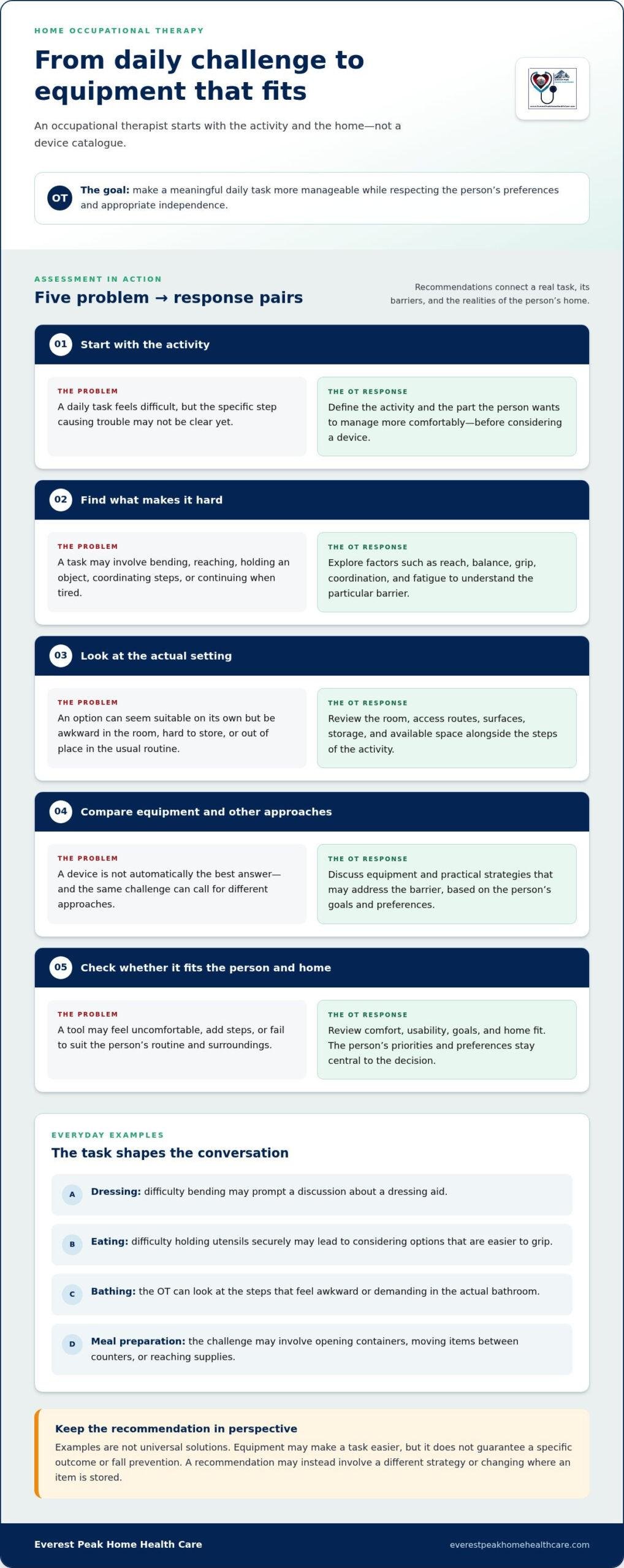
A person who finds it difficult to bend while dressing might discuss a dressing aid. Someone who struggles to hold utensils securely may consider options that are easier to grip. In the bathroom, an OT can look at the steps involved in bathing and identify where the task feels awkward or demanding. For meal preparation, the challenge might be opening containers, moving items between counters, or reaching frequently used supplies.
These are examples, not universal solutions. A tool that helps one person may feel uncomfortable or add steps for someone else. An OT can explain how an option relates to the activity and show how it may fit into a person’s routine. Equipment may make a task easier, but it should not be described as a guarantee of fall prevention or safety. For a broader overview of tools and technologies that can support function, see Assistive Technology and Adaptive Equipment.
Why an in-home OT perspective can matter
A product description cannot show how someone moves through their own kitchen or bathroom. Room layout, floor and countertop surfaces, storage locations, and paths between furniture can all affect whether an option is practical. A reaching aid, for example, needs to suit both the item being retrieved and where it is stored. A bathing strategy needs to make sense in the actual space and the person’s usual routine.
Observing an activity in its familiar setting can reveal barriers that a general equipment list may miss. The therapist can learn which steps are difficult, what the person already does successfully, and what matters most to them. This practical perspective connects recommendations with everyday goals. Everest Peak Home Health Care provides occupational therapy in patients’ homes in North Hollywood and the surrounding Los Angeles area. Learn more about in-home occupational therapy in Los Angeles and how it relates clinical guidance to daily function and the home environment.
How an occupational therapist assesses needs before recommending equipment
Equipment selection should follow an assessment of the task and home environment, because a tool is useful only when it fits the person’s abilities, goals, and daily life. An occupational therapist can identify an activity the person wants to manage more comfortably, explore what makes it difficult, consider the setting, compare possible approaches, and review how well an option fits.
This process is collaborative. The person’s priorities, preferences, routines, and comfort matter alongside clinical observations. With the person’s permission, a caregiver can share useful context, such as which parts of a routine are challenging or what support is already provided. Their input can inform the discussion while the person remains central to decisions about daily life.
- Identify the task: Define the activity and the part that feels difficult.
- Understand the challenge: Consider factors such as reach, balance, grip, coordination, or fatigue.
- Assess the setting: Review the room and the steps involved in the routine.
- Compare options: Discuss equipment and other practical strategies that may address the barrier.
- Review the fit: Consider whether an option is comfortable, usable, and suited to the person’s goals and home.
From a daily challenge to a functional goal
The conversation starts with what the person wants to do, not with a device. A goal might be getting dressed with less strain, preparing a simple meal more comfortably, or reaching frequently used items. The OT then explores where difficulty arises, such as bending, maintaining balance, holding an object, coordinating several steps, or continuing when tired. These observations help define the problem without assuming that a diagnosis calls for a standard piece of equipment. People with similar challenges may have different goals and preferences.
Considering the home, preferences, and support
The therapist considers the relevant room, access routes, surfaces, storage, and available space. An option may seem suitable on its own but prove awkward if it blocks a path, is difficult to store, or doesn’t fit the person’s routine. Comfort and confidence matter, too. The person can share concerns about privacy, appearance, or accepting help, and caregivers can join the conversation as the person wishes.
Recommendations may need to change as a person’s abilities, priorities, or routines change. The therapist can help the person and involved caregivers discuss what feels manageable and identify questions before trying an option. For individualized guidance rooted in daily function, Everest Peak’s in-home occupational therapy connects clinical assessment with the person’s goals and home setting.
How to compare adaptive equipment options for fit, use, and home setup
Comparing options is less about finding the most advanced device and more about finding a workable match for one activity. An item should support the intended task without adding unnecessary steps, discomfort, clutter, or reliance on help the person doesn’t want. More equipment does not automatically mean greater safety or independence. A poorly matched option may be difficult to operate or get in the way, so discuss practical trade-offs with an occupational therapist.
Use these questions as a framework for discussion, not as a product ranking. The same option can work well for one person and feel unsuitable for another.
Task fit: Does the option address the specific part of the activity that is difficult? Can the person use it during the routine they want to support?
Ease of use: Can the person understand the steps, reach the item, and operate it with their current grip, coordination, and range of movement?
Comfort and confidence: Does it feel comfortable and acceptable to use? Does it support the person’s confidence, privacy, and preferred level of independence?
Stability and adjustability: Does it feel appropriate for the task and the person’s abilities? Can it be adjusted if positioning or reach needs change?
Portability and storage: Is it manageable to move, clean, and store? Will it be easy to find when the task begins without creating clutter?
Home compatibility: Does it fit the available space and work with the room’s layout, surfaces, furniture, and access routes?
Which comparison factors matter in daily use?
Consider the full sequence of using an option, not just the moment it helps. A tool may make an item easier to reach but be less useful if the person can’t retrieve it from storage or put it away afterward. Consider whether setup, cleaning, adjustment, or carrying adds effort. Usability depends on the activity and the person’s abilities, so an OT can help identify which trade-offs matter most.
How the home environment affects the choice
Space and layout can change how an option works. Doorway access, bathroom dimensions, flooring, nearby furniture, and where an item is placed may affect movement and access. An option that suits one room may not be practical elsewhere, even for the same activity. Consider the home in context rather than relying on a general product description.
Some room changes may need additional assessment before they’re considered. An occupational therapist can discuss how a proposed option fits the actual setting and whether it introduces obstacles, such as narrowing a route or making storage harder to reach. Share concerns about comfort, setup, or everyday use. These details help shape adaptive equipment recommendations from OT at home around real routines, with the aim of supporting participation without adding avoidable barriers.
What to Do After OT Adaptive Equipment Recommendations
A recommendation becomes useful when it makes sense in the person’s actual routine. Before trying an option, clarify which task it is intended to support and what the occupational therapist observed or discussed. Understanding the purpose helps the person and any involved caregivers use it as intended, without expecting it to solve challenges it wasn’t selected to address.
Review these practical steps together:
- Clarify the goal: Name the activity the recommendation is meant to support and the part of it that may feel easier.
- Review instructions: Make sure the person understands how the option is intended to be used, including any guidance the OT provided.
- Prepare the relevant area: Keep needed items accessible and the activity space workable, without making unassessed changes to the home.
- Check comfort and fit: Notice whether the option feels manageable during the intended task and suits the person’s preferences.
- Include caregivers by agreement: If someone helps with setup or use, involve them in a way that respects the person’s consent and independence.
Preparing to use a recommended option
Start with the task and the OT’s instructions rather than trying to use an option for a different purpose. If a step is unclear, note the question for the treating occupational therapist. Before the activity, arrange what’s needed for that routine, such as placing relevant supplies within the person’s usual reach. A caregiver can help if the person wants support, while allowing the individual to direct how and when help is provided.
Recognizing when a recommendation needs review
Pay attention to repeated discomfort, difficulty understanding or operating the option, or a setup that feels awkward in daily use. A change in ability, priorities, or routine can also affect whether the recommendation remains a good fit. These are reasons to discuss the experience with the treating OT. Describe what happens during the task, what feels manageable, and what remains challenging. This gives the therapist practical context for reviewing the approach.
Revisiting a recommendation doesn’t mean the person has failed to use it correctly. It’s an opportunity to clarify instructions or consider whether the person’s needs have changed. Keep the conversation focused on the person’s goals and comfort. For additional support with everyday routines, personal care assistance at home may also be relevant.
To discuss how occupational therapy can support daily activities at home, learn about Everest Peak Home Health Care.
How Everest Peak’s in-home occupational therapy supports equipment decisions
Adaptive equipment decisions are most meaningful when they relate to what a person wants to do in everyday life. Everest Peak Home Health Care provides occupational therapy in patients’ homes in North Hollywood and the surrounding Los Angeles area. In a familiar setting, an occupational therapist can connect a person’s goals with the activity they find challenging and the surroundings where it takes place.
The guidance is individualized. The therapist considers the person’s abilities, preferences, and daily function alongside practical details of the home environment. The goal is to help the person understand possible approaches and how they may fit a routine, not to recommend the same product for everyone or promise a specific outcome. An assessment can inform a thoughtful discussion about what may support participation and independence.
Connecting clinical guidance with daily routines
Home-based occupational therapy can focus on the real activity behind a concern, such as completing a dressing routine, preparing food, or moving through a familiar space. The therapist can discuss which steps feel difficult, what the person hopes to manage more comfortably, and which approaches respect their priorities. This keeps clinical guidance grounded in practical goals rather than a general equipment list.
For example, a person may want to complete more parts of a routine independently, while a caregiver may be concerned about providing support without taking over. An OT can help bring those perspectives into the conversation, keeping the person’s preferences at the center. Learn more about in-home occupational therapy in Los Angeles and how it relates therapy to function and daily life.
Taking a thoughtful next step with Everest Peak
If you’re considering adaptive equipment recommendations from OT at home, start by identifying one activity that matters to you and describing what makes it challenging. Note what you’ve already tried, what feels comfortable, and what kind of support you prefer. These details can make a discussion with an occupational therapist more focused.
You don’t need to choose a device before discussing your goals. An OT can help consider how daily routines and the home setting relate to possible approaches, so decisions reflect the person’s circumstances and preferences. A measured conversation can bring clarity while preserving dignity and choice.
Explore home health support with Everest Peak to learn about care grounded in individual needs and the realities of life at home.
Take the next step toward a routine that feels more manageable
Choose one daily activity that matters to you and notice what would make it feel more comfortable or manageable. You don’t need to arrive with a solution in mind. Describing what you hope to do, what feels challenging, and what support feels acceptable gives an occupational therapist a useful place to begin.
That conversation can turn adaptive equipment recommendations from OT at home into informed choices grounded in your priorities. You remain an essential part of deciding what feels practical and respectful. If a recommendation doesn’t feel right, your concerns deserve attention and discussion.
Everest Peak Home Health Care provides in-home occupational therapy in North Hollywood and the surrounding Los Angeles area. Explore in-home occupational therapy with Everest Peak to take a thoughtful next step toward daily routines that reflect your goals and sense of independence.
Frequently Asked Questions
Does an occupational therapist recommend the same adaptive equipment to everyone with the same condition?
No. A diagnosis alone doesn’t determine which equipment will suit someone. Two people with the same condition may have different abilities, priorities, home layouts, and ways of completing a task. One person may value doing an activity independently, while another may prefer an option that makes it easier to accept help. An occupational therapist considers those differences so guidance reflects the individual rather than a standard device for a diagnosis.
Can an occupational therapist assess adaptive equipment needs during a home visit?
Yes. A home visit lets an occupational therapist observe the activity and surroundings that affect it. In North Hollywood and nearby Los Angeles communities, for example, the OT can see where commonly used items are kept and how the person moves through the relevant space. That context can reveal practical details that are hard to explain from memory and help make recommendations more relevant to daily life in California.
What should I tell an OT before discussing adaptive equipment?
Describe the activity you want to manage, what part feels difficult, and when the challenge tends to occur. Mention what you’ve already tried, what you’d like to keep doing yourself, and whether fatigue or discomfort affects the task. Share preferences about appearance, privacy, or accepting assistance, too. You don’t need to know which device to request. Observations about daily life give the OT a useful starting point.
Is adaptive equipment always the best way to make a daily task easier?
No. Equipment is one possible approach, not the only one. A task may become more manageable through a different sequence, a change in where supplies are kept, or a way of organizing the activity around the person’s energy and abilities. An occupational therapist can discuss whether a tool addresses the main difficulty or adds unnecessary steps. The right approach is one that supports a meaningful activity and feels workable to the person.
Can family caregivers help someone use adaptive equipment?
Yes, if the person welcomes their involvement and the caregiver understands the instructions. A caregiver might help set up an activity, place an item within reach, or give a reminder, while allowing the individual to do the parts they can manage. Agreeing on what kind of help is wanted can prevent assistance from feeling intrusive. If a caregiver is unsure about a step, they can raise that question with the occupational therapist.
Will insurance cover adaptive equipment recommended by an occupational therapist?
Coverage isn’t automatic. It depends on the item, how it’s classified, and the person’s plan. Some equipment used for daily activities may be treated differently from durable medical equipment, which can have separate coverage requirements. Medicaid benefits and waiver programs also vary by state, including in California. Before budgeting, review the specific item and coverage rules with the insurer or relevant benefits program. An OT’s recommendation alone doesn’t guarantee payment.
When should an adaptive equipment recommendation be reviewed?
Ask the treating occupational therapist to review an option if it causes discomfort, is difficult to use, or no longer supports the intended activity. A change in strength, movement, confidence, home setup, or daily routine may also affect its fit. For instance, a person’s needs may shift after recovery or when household responsibilities change. Describe what happens during use and what has changed so the OT can help determine an appropriate next step.