

What if the way forward isn’t getting every relative to agree, but creating a shared process that keeps your loved one’s needs at the center? Navigating family dynamics in elder care can be difficult when relatives disagree about what support is needed, one person carries most of the work, or distance, jobs, and family history complicate conversations. Start by listening to the older adult, then make each person’s concerns and practical limits clear.
This guide offers a way to hold focused family discussions, divide responsibilities according to each person’s capacity, and build a care plan that respects your loved one’s preferences. You’ll find ways to clarify immediate needs, communicate across schedules and distance, and revisit arrangements as circumstances change. Medical social workers can support communication and care coordination while families and older adults remain involved in decisions. At home, skilled nursing, therapy, and personal care assistance can complement the practical help relatives provide.
Key Takeaways
- Recognize how uncertainty and differing views of care can shape family communication and responsibilities.
- Make space for the older adult to express preferences instead of relying on relatives’ assumptions.
- Separate disagreements about facts, priorities, and tasks to guide calmer, more focused discussions.
- When navigating family dynamics in elder care, match responsibilities to each person’s capacity and document the plan.
- Understand how nurses, therapists, and medical social workers can contribute professional care and coordination while families retain decision-making roles.
Why elder care family dynamics feel so difficult
Disagreement about an older relative’s care doesn’t automatically mean anyone is uncaring. It often grows from concern, uncertainty, and different interpretations of changing needs. One person may prioritize preventing falls, while another worries that added help could limit independence. Both may be trying to protect someone they love, even if they reach different conclusions.
Family dynamics in elder care are the patterns that shape how relatives communicate, make decisions, and take on caregiving responsibilities. These patterns influence whose observations get heard, how tasks are assigned, and how the family responds when a plan needs to change. Recognizing those patterns helps relatives address the care issue at hand without treating every disagreement as a judgment of someone’s character.
Separate an immediate care concern from older relationship tensions. A disagreement about whether a parent needs help with bathing is a practical question. Resentment about who has historically been expected to help is a separate issue. Both may come up in the same conversation, but naming them separately makes it easier to address current needs without turning the discussion into a review of past family grievances.
The older adult’s preferences and dignity should guide coordination. Ask what support feels acceptable, which routines matter, and where the person wants to retain choice. The overview of elderly care discusses the range of support involved and the importance of promoting independence. In practice, consider safety alongside the older adult’s priorities instead of letting relatives’ assumptions stand in for their wishes.
How changing care needs can expose family differences
A change in health or daily functioning can bring different views of safety, independence, and support into focus. A relative who notices missed meals may favor more assistance, while someone who sees the older adult managing familiar routines may believe current support is sufficient. Each person may be seeing a different part of daily life, not the whole picture.
Compare specific observations instead of labeling someone’s position as careless or overprotective. Ask what happened, when it happened, and what support the older adult wants. Different conclusions call for a closer conversation, not an assumption that someone doesn’t care.
When distance, history, and expectations shape caregiving
Geography and daily commitments affect what each relative can contribute. Someone nearby may handle appointments, while a family member living farther away may be better placed to coordinate calls or paperwork. Work schedules, finances, health, and previous caregiving experience also shape capacity. Fairness doesn’t require identical contributions. It requires an honest account of what each person can sustain.
Unspoken expectations can create friction, especially if relatives assume one person will organize care or provide hands-on help without discussing it. Avoid assigning duties based on gender, birth order, or who lives closest. Make expectations explicit, invite the older adult’s input, and distinguish willingness from practical capacity. This gives the family a clearer starting point while preserving respect for everyone involved.
How to keep an older adult’s preferences at the center of care
Family members may have strong ideas about what would make an older adult safer or more comfortable. Those ideas can be useful, but they don’t replace asking the person directly. Separate what they have actually expressed from what relatives assume they would want. Make room for preferences about daily routines, privacy, relationships, and independence.
Include the older adult in decisions to the fullest practical extent. This principle gives the family a steady reference point when navigating family dynamics in elder care, especially when opinions differ. Participation can take different forms: the person might lead a conversation, share preferences one-on-one, or respond to a short list of options. Make a genuine effort to hear them rather than treating decisions as a discussion only among relatives.
Questions that invite the older adult into the conversation
Choose a calm, private setting where the older adult can participate comfortably. Ask open questions, then allow time for an answer without filling every pause or turning the meeting into an interrogation. For example: “Which parts of your daily routine matter most to you?” “What would you like to keep doing on your own?” “What concerns you about accepting help?”
Follow up with questions about relationships and practical preferences: “Who would you like involved in decisions?” or “What would make a change feel more manageable?” If a group conversation feels overwhelming, invite the person to share their thoughts beforehand or speak with a trusted relative first. Repeat what you heard in neutral language and give them a chance to clarify. Listening well means being open to an answer that differs from what the family expected.
Balancing preferences with safety and changing needs
Acknowledge the preference before raising a concern. If an older adult wants to keep preparing meals but a relative is worried about a particular task, discuss the specific concern rather than dismissing the person’s independence. Identify what remains uncertain and bring relevant questions to an appropriate care professional, who can offer observations within their role.
Preferences can change as health, routines, or available support changes. Revisit the conversation when circumstances shift, and record the person’s current priorities along with questions that still need attention. Avoid treating a previous answer as permanent or promising that every preference can be accommodated. Instead, explore options respectfully and explain practical limits clearly.
Care coordination may also involve support for relatives themselves. The Administration for Community Living’s National Family Caregiver Support Program describes resources such as information, training, counseling, referrals, and respite care for family caregivers. For families considering clinical or personal support at home, home health care support can complement relatives’ practical help while keeping the older adult’s expressed priorities part of the conversation.
How to handle disagreements about an older family member’s care
Before looking for a compromise, identify what kind of disagreement the family is having. Relatives may dispute the facts, such as how often a problem occurs; the priorities, such as safety versus independence; or the preferred way to handle a task, such as who accompanies an older adult to an appointment. Each difference needs a different response. Clarifying the issue prevents a practical question from becoming a debate about who cares more.
Start by summarizing each person’s concern in neutral language. For example: “You’re concerned about falls because you’ve noticed unsteadiness on the stairs. You’re concerned that moving rooms could disrupt Dad’s routine.” Ask whether each summary is accurate before discussing options. Listen to understand first. Agreement is easier to explore when each person feels heard.
If voices rise or the conversation shifts toward blame, pause rather than force a decision. Name a time to return to the discussion, and note what information or reflection would help before then. A pause works best when it has a clear next step, so it doesn’t feel like avoidance. When navigating family dynamics in elder care, protecting the quality of the conversation can matter as much as reaching a decision quickly.
Use a focused family meeting to surface concerns
Give the meeting one purpose, such as discussing transportation to appointments, and share relevant information beforehand so no one has to react to surprises. Agree that each person will have time to speak without interruption. Invite everyone to name one concern and one contribution they could realistically make. Keep the conversation tied to the older adult’s priorities rather than past grievances.
For instance, one relative might be worried about missed appointments and offer to coordinate reminders, while another may be concerned about the burden of travel and suggest helping arrange rides. The contributions don’t need to be identical. A facilitator can write down each concern, proposed action, and unanswered question, then read the notes back so participants can correct misunderstandings before the meeting ends.
What to do when relatives remain divided
Some questions won’t be resolved in one conversation. Record the point of disagreement, what information is missing, and who will follow up. Separate decisions that can wait from concerns that need timely clinical guidance. If relatives disagree about a change in symptoms or a care task, direct the clinical question to an appropriate clinician instead of trying to settle it through family debate.
When family discussion alone cannot move forward, a neutral professional may help clarify the process. A medical social worker can support communication and care coordination without replacing family decision-making. Nurses and therapists can also share care-related observations within their professional roles. Their input can help relatives understand relevant information, while the family and older adult remain involved in choices that concern daily life.
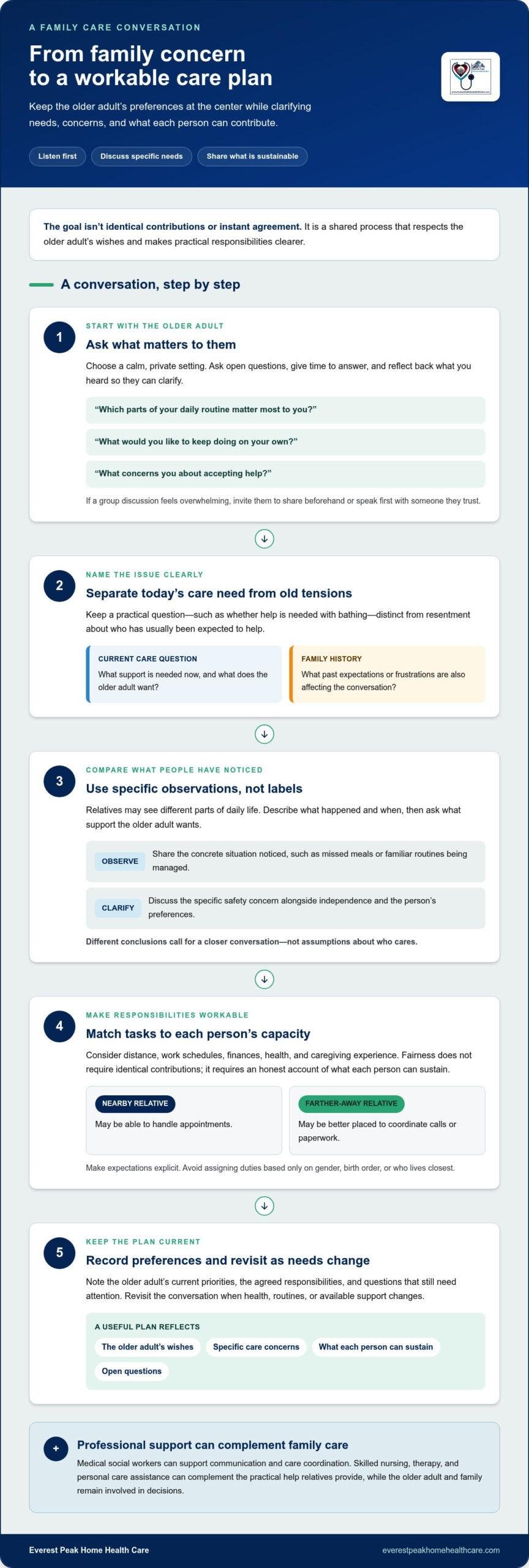
How to share elder-care responsibilities fairly and make a workable plan
A workable care plan makes responsibilities visible instead of leaving them to informal assumptions. Fairness doesn’t mean every relative takes the same number of tasks. It means the older adult’s needs are addressed, each person’s contribution reflects their actual capacity, and no assignment depends on an unspoken promise.
Use this five-step process to turn a family discussion into a plan you can revisit:
- 1. List the needs. Separate clinical care from household tasks, transportation, companionship, and communication. Note what is needed, how often, and what the older adult prefers.
- 2. Map capacity. Ask each relative what they can reliably do, considering availability, skills, distance, and boundaries. Include remote contributions such as scheduling appointments or sharing updates.
- 3. Assign tasks. Name one owner for each responsibility and identify a backup where possible. Appropriate professionals should handle clinical care; relatives can coordinate practical support according to their abilities.
- 4. Record agreements. Write down the task, owner, frequency, backup, and any information needed to complete it.
- 5. Set a review date. Choose a time to check whether assignments still fit the older adult’s needs and everyone’s capacity.
A simple shared plan might say: “Transportation to appointments, Alex, as scheduled, backup Jordan, review at the next family check-in.” For a recurring household task, record the same details rather than relying on a text thread or memory. A written plan gives relatives a common reference and makes gaps easier to spot before they become a source of frustration.
Match responsibilities to real capacity, not assumptions
Invite each relative to state both what they can take on and what they cannot. One person may be able to visit regularly but not manage appointment calls during work hours; another may live farther away yet have time to organize schedules or distribute family updates. These contributions differ, but both can support care.
Don’t judge fairness by counting tasks alone. Consider the time, frequency, travel, and level of responsibility involved, and let the older adult’s preferences inform the arrangement. As circumstances change, assignments can change too.
Create a communication and review routine
Agree on one method for routine updates and clarify who shares important changes, with whom, and how promptly. Keep messages factual and respectful, and share personal care information only with appropriate family participants. Record observations clearly, distinguishing what someone directly noticed from what they think it may mean.
Revisit the plan when care needs, schedules, or preferences shift. For support that includes professional care at home, explore home health care support as a complement to the practical help relatives provide. A plan with clear owners, backups, and review points can make navigating family dynamics in elder care more manageable over time.
When professional home health support can help families coordinate care
Family members coordinate daily life, share updates, and make decisions with the older adult. Home health professionals have a different role: they provide clinical or personal care within their professional responsibilities and communicate care-related observations. These roles can complement one another. Professional input can help relatives discuss specific needs using clearer information, while family members bring their knowledge of the person’s routines, preferences, and relationships.
For families navigating family dynamics in elder care, distinguish a clinical question from a family decision. A nurse may share an observation related to care, while relatives and the older adult discuss how that information fits with daily priorities and practical support. A clinician’s input informs coordination; it doesn’t replace the older adult’s voice or the family’s role in decisions.
How a home health team can contribute
Skilled nursing care can address clinical needs and provide relevant care-related observations. Physical therapists work on movement and mobility; occupational therapists address daily activities; and speech therapists support communication and swallowing within their professional roles. Each discipline offers a distinct perspective, helping the family understand which questions relate to clinical care and which are practical matters for family planning.
Medical social services can support communication and care coordination as families adjust to home health needs. A medical social worker may help clarify questions, support communication among appropriate participants, and coordinate care-related information without taking over family decision-making. The medical social worker home visits guide explains how this support can fit into care at home. For a broader overview of clinical care in the home, see the home health care guide for North Hollywood.
Before speaking with a care professional, prepare a concise summary: what concern you’ve noticed, when it occurs, the older adult’s preferences, and which practical responsibilities relatives have agreed to manage. This gives the discussion a useful starting point without asking a clinician to resolve family disagreements. Bring relevant questions to the professional whose role fits the concern, and note any guidance the family needs to understand or follow up on.
Taking a calm next step as a family
Home health support doesn’t remove the need for family communication. It can add professional care and relevant observations to a plan that accounts for the older adult’s priorities and relatives’ contributions. If home-based clinical or personal care could complement your family’s support, explore Everest Peak Home Health Care and its home health services.
Take the next step with steady support
Family care arrangements can evolve as an older adult’s needs and preferences change. Rather than expecting one conversation to settle everything, treat coordination as an ongoing practice: stay open to new information, keep the older adult involved, and adjust the plan when it no longer fits. That steady approach can make navigating family dynamics in elder care more manageable over time.
For families in North Hollywood and the surrounding Los Angeles area, Everest Peak Home Health Care provides in-home support that can complement the help relatives provide. Its multidisciplinary team includes nurses, therapists, and medical social workers who contribute care within their professional roles. Family members remain important partners in everyday support and decisions.
Explore home health support for your family and discuss how skilled nursing, therapy, medical social services, or personal care assistance may support your loved one at home.
Frequently Asked Questions
How do you handle siblings who disagree about an elderly parent’s care?
Ask each sibling to describe the specific event or concern behind their recommendation, then compare the options against shared priorities such as comfort, independence, and daily routine. For example, if one sibling wants more help at home and another prefers waiting, list what each option would change this week and what information is still missing. This keeps navigating family dynamics in elder care focused on practical choices rather than competing judgments about who understands the parent best.
How can families divide caregiving responsibilities fairly?
Fairness means sharing the overall effort in a way that reflects each person’s capacity, not assigning everyone the same number of tasks. For a week, note the time involved in appointments, calls, visits, and coordination. Then ask whether each person’s contribution remains sustainable. One relative might handle an occasional appointment, while another manages regular scheduling. Revisit the distribution if work demands, travel, or the older adult’s needs change.
What should you do when an older adult refuses help?
Ask what part of the offer feels uncomfortable before pressing for an answer. The person may be worried about privacy, losing control, or changing a familiar routine. Offer a limited choice, such as accepting help with one specific activity while keeping other routines unchanged, and ask whether they would consider trying it for a short period. If the refusal is connected to a new health concern, share that concern with an appropriate health professional.
Can a family meeting help resolve elder-care disagreements?
Yes, a well-planned meeting can help relatives leave with clearer next steps, even if they don’t agree on every issue. Send a short agenda in advance, choose one decision to discuss, and ask participants to bring relevant observations rather than assumptions. End by confirming what will happen next, who will follow up, and when the family will check back. If someone cannot attend, share the agreed notes with them afterward.
When should a family seek professional support for elder care?
Seek professional input when a question involves clinical care, changing symptoms, rehabilitation, or a task relatives aren’t prepared to manage. In California, home health professionals such as nurses and therapists can contribute care within their professional roles, while medical social workers may help with communication and care coordination. This support can inform family planning without taking over the older adult’s preferences or relatives’ decisions about practical responsibilities.
How can long-distance family members help care for an older adult?
Relatives who live far away can take responsibility for tasks that don’t require being physically present. They might coordinate appointment calendars, gather questions before a care discussion, or share agreed updates with family members. Ask the older adult which information they want shared and with whom, then use a consistent method to avoid conflicting messages. A remote contribution is most useful when it has a clear owner and doesn’t duplicate work already handled locally.
What happens if family caregivers disagree about safety concerns?
Describe the concrete event that raised concern, including what was observed and when, before deciding what it means. A missed step on the stairs, for instance, is a specific observation; assuming it proves the person can no longer use them safely is an interpretation. Record the question and discuss it with an appropriate clinician if it relates to health or mobility. If there’s immediate danger, contact emergency services rather than waiting for a family meeting.