
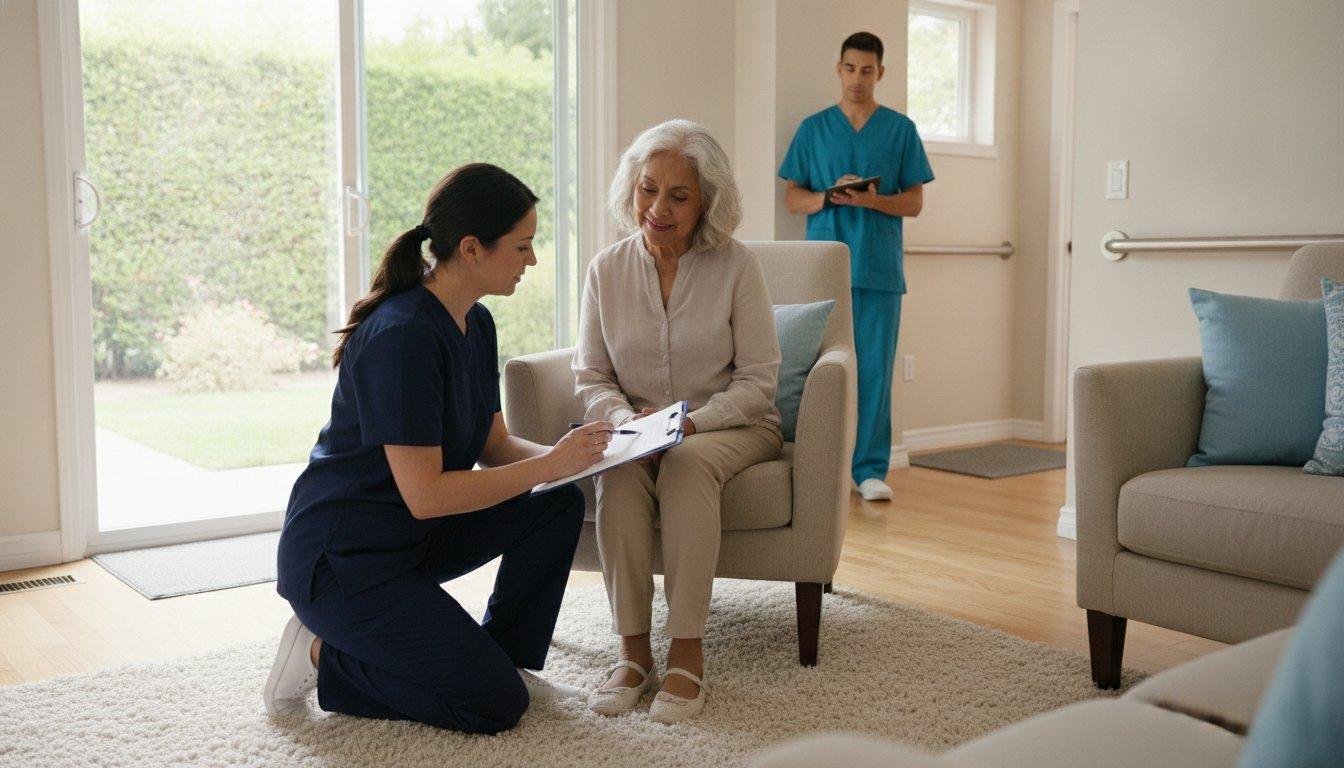
Most families assume that keeping an elderly parent safe at home means tucking away loose rugs and installing a grab bar or two. That assumption, while well-intentioned, misses the deeper clinical picture entirely. A thorough home safety assessment for elderly individuals is not a simple checklist; it’s a systematic evaluation of how a person’s specific physical capabilities, cognitive function, and sensory limitations interact with every corner of their living environment.
If you’ve found yourself lying awake wondering whether your parent is safe alone, or feeling overwhelmed by discharge paperwork after a recent hospitalization, you’re not alone. Those concerns are valid, and they deserve a structured, professional answer rather than guesswork.
This clinical guide will walk you through exactly what a comprehensive home safety assessment covers, which hazards are most frequently overlooked, and how licensed occupational therapists, physical therapists, and skilled nurses work together to create a clear, actionable plan for aging safely and independently at home. By the end, you’ll have the knowledge to take confident next steps for your loved one’s care.
Key Takeaways
- A professional home safety assessment for elderly individuals goes far beyond basic checklists — it is a clinical evaluation that examines how a person’s specific physical and cognitive limitations interact with their living environment.
- Occupational Therapists and Physical Therapists serve distinct but complementary roles in risk evaluation, with PTs focusing on gait and balance while OTs assess functional tool use and daily activity safety.
- Licensed clinicians use specialized equipment to detect “invisible” hazards — such as insufficient lighting levels and low-friction flooring — that standard DIY checklists routinely fail to identify.
- Room-by-room modifications, particularly in the kitchen and bathroom, follow a structured clinical strategy rather than a one-size-fits-all approach, ensuring interventions are matched to each individual’s functional profile.
- Families in North Hollywood and the greater Los Angeles area can access coordinated home safety evaluations through licensed Occupational Therapy, Physical Therapy, and Medical Social Services — all delivered directly in the home setting.
What is a Home Safety Assessment for the Elderly?
A home safety assessment for elderly individuals is a structured clinical evaluation conducted by licensed healthcare professionals to systematically identify environmental risks that threaten a senior’s physical safety and functional independence. Unlike a general home inspection, this process is inherently medical in nature. It examines the precise intersection between a person’s documented health conditions, their current functional capabilities, and every physical characteristic of their living space, from doorway widths to stair riser heights to the friction coefficient of bathroom tile.
Fall prevention sits at the center of this evaluation. Falls remain the leading cause of injury-related death among adults aged 65 and older, according to the Centers for Disease Control and Prevention, and the majority of those falls occur within the home. That single statistic reframes how clinicians approach the assessment: every observation is filtered through the question of what specific risk this environment poses to this particular person, given their unique clinical profile.
Current 2026 standards have expanded that clinical lens considerably. A comprehensive evaluation now integrates cognitive screening, sensory health review, and medication side-effect analysis alongside the traditional physical hazard inventory. A senior experiencing mild cognitive impairment, for example, faces a categorically different risk profile than one with intact cognition but significant lower-extremity weakness, even if their living spaces look identical on the surface. This is precisely why occupational therapy home safety evaluations have become a foundational component of modern home-based care, providing the functional analysis necessary to translate clinical findings into targeted environmental solutions.
The Core Objectives of Professional Evaluation
A licensed clinician enters the home with three parallel objectives. First, identifying physical hazards: lighting levels measured against clinical thresholds, flooring surfaces assessed for slip resistance, clutter patterns that compromise safe navigation pathways, and threshold heights that challenge altered gait mechanics. Second, evaluating the senior’s ability to perform Activities of Daily Living, including bathing, meal preparation, medication management, and safe ambulation between rooms. Third, translating those combined findings into a customized modification roadmap, one that prioritizes interventions by urgency and matches each recommendation to the individual’s specific functional profile rather than applying generic solutions.
When to Schedule an Assessment
Three clinical situations call for an immediate evaluation:
- Following hospital discharge or post-surgical recovery: Functional status changes rapidly after a procedure, and a home environment that was safe six weeks ago may now present serious hazards.
- When balance issues or dizziness become frequent: These symptoms indicate an elevated fall risk that warrants a professional environmental review before an incident occurs.
- As a proactive measure for aging in place: Families who address environmental risks before a fall or functional decline occurs consistently report better long-term outcomes for their loved ones.
Scheduling proactively, rather than reactively, is consistently the more clinically sound decision.
The Clinical Difference: How Occupational and Physical Therapists Evaluate Risk
Reading a checklist and watching a person move through their home are fundamentally different clinical activities. The most significant gap in standard online guidance is precisely this: it describes what to look for, but never accounts for how an individual senior actually navigates their specific environment. A licensed Physical Therapist and an Occupational Therapist each bring a distinct clinical lens to a home safety assessment for elderly individuals, and understanding that distinction helps families appreciate why professional evaluation produces outcomes that no worksheet can replicate.
Physical Therapists concentrate their evaluation on the biomechanics of movement itself. They observe gait patterns, assess balance under real-world conditions, and analyze the physical demands that specific home features place on a senior’s musculoskeletal and neurological systems. An OT’s focus is equally precise but oriented differently: they examine how a person interacts with the tools, appliances, and surfaces of daily life, assessing whether a senior can safely manage a stovetop burner, retrieve items from a high cabinet, or handle a medication bottle without risking a fall or injury. These two disciplines are complementary, not interchangeable.
Critically, both disciplines integrate a patient’s medical history directly into their environmental observations. A diagnosis of peripheral neuropathy changes how a clinician interprets bathroom tile selection. A recent stroke affects how a hallway width is evaluated relative to walker clearance. The clinical assessment doesn’t examine the home in isolation; it examines the home through the lens of that specific person’s documented health profile.
Functional Mobility and Transfer Assessments
Functional mobility is the ability to move safely and purposefully within one’s own environment. A Physical Therapist evaluates this by observing the senior actually performing transfers, not describing them. Can they rise from their own sofa, which may be lower and softer than a clinical chair? How do they negotiate the specific riser height of their staircase? Does their walker fit through the bathroom doorway without requiring a compensatory movement that disrupts their balance? These observations generate findings that no self-reported questionnaire can capture with equivalent accuracy.
Cognitive and Sensory Considerations
Sensory and cognitive changes introduce hazards that are invisible to a standard visual inspection. Age-related vision changes reduce contrast sensitivity and depth perception, making it genuinely difficult to judge the edge of a stair tread accurately. For seniors with cognitive decline or early dementia, clinicians also assess wayfinding, evaluating whether the home’s lighting and layout support safe, independent navigation between rooms at night. Medication-related dizziness is another factor that receives direct clinical attention, since a drug regimen that produces postural hypotension transforms an otherwise safe hallway into a significant fall risk.
Families seeking this level of integrated clinical analysis can connect with the licensed Physical and Occupational Therapy specialists at Everest Peak Home Health Care, who conduct these evaluations directly within the home setting across North Hollywood and the greater Los Angeles area.
Professional Assessment vs. DIY Checklists: Identifying Hidden Risks
There’s a meaningful difference between walking through a parent’s home with good intentions and conducting a clinical evaluation of that environment. Printed checklists and online guides serve a purpose, but they operate on the assumption that the person using them can recognize what they’re looking for. Most families cannot, and that’s not a criticism. It’s simply a reflection of the specialized training required to detect the hazards that cause the most serious injuries.
Invisible risks are the most dangerous category. Low-contrast thresholds between flooring materials, for example, are visually imperceptible to most observers yet genuinely hazardous to a senior with reduced contrast sensitivity. A licensed clinician conducting a home safety assessment for elderly individuals brings calibrated light meters to measure foot-candle levels against established clinical thresholds, and uses surface friction testing tools to evaluate slip resistance on bathroom and kitchen flooring. These are not instruments a family member carries on a Sunday afternoon walkthrough.
The Limits of the Family Walkthrough
Familiarity is a liability in this context. Family members who visit regularly develop a kind of environmental blindness to the hazards that have always been present. The step down into the garage, the kitchen cabinet that requires a reach above shoulder height, the bathroom door that opens inward and restricts transfer space: these features become invisible through repetition. Emotional investment compounds the problem. Acknowledging that a parent’s home is genuinely unsafe is a difficult conclusion to reach, and that difficulty can unconsciously shape what a family member chooses to see.
There are also knowledge gaps that no amount of care can compensate for. Without familiarity with ADA standards for grab bar placement, load-bearing requirements, and ramp gradient specifications, a well-meaning modification can create a false sense of security rather than genuine protection.
What a Clinical Report Includes
The documentation produced by a licensed clinician is substantively different from a handwritten list of suggestions. A formal clinical report delivers:
- A prioritized modification inventory: Hazards are categorized by immediacy, distinguishing between risks requiring urgent intervention and those that can be addressed on a planned timeline.
- Durable Medical Equipment recommendations: Any assistive device, whether a shower chair, raised toilet seat, or walker, is specified to the patient’s body measurements and functional capacity rather than selected generically.
- Integration with the existing care plan: For patients already receiving Skilled Nursing or Physical Therapy services, the environmental findings are coordinated directly with the treating clinical team, ensuring that home modifications align with active rehabilitation goals.
That last point carries particular weight. A home safety assessment for elderly individuals doesn’t exist in isolation from the broader clinical picture. When the environmental evaluation is conducted by the same licensed professionals managing a patient’s Physical Therapy or Occupational Therapy plan, the recommendations reinforce one another rather than working at cross-purposes. Families in North Hollywood and the greater Los Angeles area can access this level of coordinated clinical evaluation through Everest Peak Home Health Care’s licensed therapy and skilled nursing team, who conduct these assessments directly within the home setting.
Room-by-Room Safety Strategy: Implementing Practical Modifications
Clinical findings from a home safety assessment for elderly individuals only produce results when they translate into specific, prioritized modifications within each room. The environmental profile of a kitchen presents categorically different risks than a bedroom or living area, and effective intervention requires treating each space on its own clinical terms rather than applying blanket solutions across the home.
The Bathroom: Eliminating the #1 Fall Zone
The bathroom is consistently the highest-risk room in the home for older adults, and the reasons are structural. Wet surfaces, confined transfer spaces, and the physical demands of bathing and toileting combine to create a concentrated hazard environment that demands precise clinical intervention.
Grab bar placement is one of the most frequently misunderstood modifications families attempt independently. A towel bar is not a grab bar. The distinction isn’t cosmetic; it’s load-bearing. Clinically specified grab bars must be anchored into wall studs or with appropriate backing plates, positioned at heights and angles that correspond to the individual’s specific transfer mechanics, not a generic measurement. An Occupational Therapist determines placement by observing how the patient actually moves through the transfer sequence, identifying the exact points where lateral support is needed.
Raised toilet seats and roll-in or walk-in shower configurations address the biomechanical reality of compromised lower-extremity strength. Standard toilet heights require significant hip and knee extension to rise from; a raised seat reduces that demand measurably. Similarly, eliminating a shower curb removes the single-leg balance requirement that precedes many bathroom falls.
The non-slip coefficient of friction is a standardized measure of a surface’s resistance to sliding under wet conditions, and bathroom flooring that falls below clinically accepted thresholds requires either replacement or the application of anti-slip treatment products.
Kitchen and Bedroom: Accessibility and Nighttime Safety
In the kitchen, the primary clinical concerns are reach distance, fire risk, and organizational logic. Items used daily should be stored between hip and shoulder height to eliminate overhead reaching and floor-level bending. Stove knob configurations and appliance placement are evaluated relative to the senior’s dominant hand function and any documented upper-extremity limitations.
The bedroom requires a different focus: safe, unassisted navigation during nighttime hours when disorientation and reduced alertness compound fall risk. The bed height should allow both feet to rest flat on the floor when seated at the edge. A telephone or personal emergency response device must be reachable from the bed without requiring the senior to stand first.
Lighting and Pathways: The 2026 Tech Integration
Generic advice like “keep a flashlight by the bed” doesn’t account for the reality that a senior with balance impairment may not safely reach a nightstand in the dark. Motion-activated lighting installed along the path from bedroom to bathroom eliminates that gap entirely, triggering automatically without requiring any deliberate action from the senior.
Smart home integration has expanded the clinical toolkit considerably. Fall-detection sensors, door and motion alerts, and smart lighting systems that activate along habitual nighttime routes now represent a practical and accessible layer of environmental safety. These technologies don’t replace clinical modifications; they reinforce them by providing continuous passive monitoring between caregiver visits.
Area rugs and electrical cords remain among the most commonly cited hazards in home safety literature, and they remain common precisely because families underestimate them. Any rug without a non-slip backing and secure perimeter adhesion should be removed. Electrical cords routed across walking paths should be rerouted along baseboards or eliminated through furniture reconfiguration.
Families ready to move from general awareness to a structured, clinically guided plan can connect with the licensed Occupational and Physical Therapy team at Everest Peak Home Health Care, who conduct room-by-room evaluations directly in the home across North Hollywood and the greater Los Angeles area.
Professional Home Health Support in North Hollywood and Los Angeles
Everest Peak Home Health Care operates as a specialized clinical partner for families throughout North Hollywood and the wider San Fernando Valley. We understand that a home safety assessment for elderly patients is most effective when it’s integrated into a comprehensive care plan rather than treated as a standalone service. Our multidisciplinary team, which includes Licensed Registered Nurses and Physical and Occupational Therapy specialists, ensures that environmental safety is addressed alongside clinical recovery goals to promote long-term functional autonomy.
Medical Social Workers play a pivotal role in this process by bridging the gap between clinical recommendations and practical implementation. While a Physical Therapist identifies the specific need for a ramp or a grab bar based on a patient’s gait, our Medical Social Workers help families navigate the logistical complexities of coordinating these modifications. They act as a stabilizing force, providing the organizational support necessary to transform a clinical report into a safer living environment. This coordinated approach is particularly vital during the transition from a hospital or rehabilitation facility back to a residence in the Los Angeles area, where clear discharge planning can significantly reduce the risk of readmission.
Local Expertise for Los Angeles Seniors
The residential architecture in North Hollywood and surrounding Los Angeles neighborhoods often includes older homes with unique structural challenges. Many of these properties feature narrow hallways, high door thresholds, and original bathroom layouts that don’t meet modern accessibility standards. Our clinicians are specifically trained to evaluate these “legacy” environments and provide solutions that work within existing footprints. We maintain deep connections with local resources and programs in the San Fernando Valley to help families secure necessary equipment and facilitate home modifications that respect the integrity of the home while prioritizing patient safety.
Starting Your Journey to a Safer Home
Initiating a professional home safety assessment for elderly loved ones typically begins with a referral from a primary care physician. Once an order is received, our team schedules an initial home visit to conduct a baseline evaluation of the patient’s functional status and environmental risks. During this first visit, you can expect a thorough, unhurried review of the home’s layout, an assessment of the senior’s mobility, and a clear discussion regarding the next steps for care. We prioritize transparency and clinical rigor, ensuring that every recommendation is grounded in the patient’s specific medical needs.
Our commitment to clinical excellence in the LA community is built on the belief that every senior deserves to age with dignity in a space that supports their independence. Taking this proactive step provides the peace of mind that comes from knowing a professional clinical team is guarding your loved one’s well-being. To begin this process, you can Contact Everest Peak today for a professional home health consultation.
Take the Next Step Toward a Safer Home
A home safety assessment for elderly individuals is not a precaution reserved for moments of crisis. It’s a proactive clinical decision that protects independence, reduces fall risk, and gives families a clear, professionally grounded plan rather than guesswork. The clinical distinction between a licensed therapist’s evaluation and a DIY walkthrough is real, and so are the consequences of that gap.
Three points from this guide are worth carrying forward. First, physical and cognitive changes interact with the home environment in ways that require trained clinical eyes to detect accurately. Second, Occupational and Physical Therapists serve distinct but complementary roles that no checklist can replicate. Third, modifications are most effective when they’re coordinated with an active care plan rather than applied in isolation.
Everest Peak Home Health Care’s Licensed Registered Nurses and Physical and Occupational Therapy specialists conduct these evaluations directly in the home, serving North Hollywood and the greater Los Angeles area. Don’t wait for a fall to prompt the conversation.
Schedule a clinical home health assessment with Everest Peak today and take confident, informed action for your loved one’s safety.
Frequently Asked Questions About Home Safety Assessments for the Elderly
Does Medicare cover a home safety assessment for the elderly?
Medicare Part A and Part B can cover a home safety assessment for elderly patients when it’s conducted by a licensed Occupational Therapist or Physical Therapist as part of a qualifying home health plan of care. Coverage requires that the patient meet Medicare’s homebound criteria and that a physician has ordered the home health services. The environmental evaluation is typically integrated into the broader therapy visit rather than billed as a standalone service.
Families should confirm their specific coverage details directly with their Medicare plan or a licensed home health agency, since coverage determinations depend on individual eligibility and the documented medical necessity of the services ordered.
What is the difference between an occupational therapist and a general contractor for home safety?
An Occupational Therapist evaluates how a specific person’s functional limitations interact with their environment, then prescribes modifications based on that clinical analysis. A general contractor executes construction work but has no clinical training to assess whether a modification actually addresses a patient’s biomechanical or cognitive needs. Installing a grab bar in the wrong location, for example, can create a false sense of security rather than genuine protection.
The most effective approach pairs both professionals. An OT determines what modifications are clinically necessary and specifies precise placement requirements; a qualified contractor then implements those specifications correctly. One without the other leaves a meaningful gap in the process.
How often should a home safety assessment be updated?
A home safety assessment should be revisited whenever a significant change in health status occurs, not on a fixed calendar schedule. Hospital discharge, a new diagnosis, a fall, a change in medications, or a noticeable decline in balance or cognition each represent clinical triggers that warrant a fresh evaluation. The home environment that was safe twelve months ago may present serious hazards today if a person’s functional profile has shifted.
For seniors who are stable and aging in place without acute changes, a periodic review every one to two years is a reasonable general guideline, though a clinician familiar with the patient’s care plan is best positioned to make that determination individually.
Can a home safety assessment help prevent my parent from having to move to assisted living?
Yes, and this is one of the most clinically meaningful outcomes a professional evaluation can support. Many transitions to assisted living are precipitated by a fall or a functional decline that a safer home environment could have delayed or prevented. When environmental hazards are systematically identified and addressed alongside an active Physical or Occupational Therapy plan, seniors are often able to maintain the independence necessary to remain in their own homes considerably longer.
The key distinction is that environmental modifications work best as part of a coordinated clinical strategy, not as isolated changes. Combining targeted home modifications with skilled therapy services produces outcomes that neither approach achieves as effectively on its own.
What are the most common home hazards found during a professional assessment?
Clinicians consistently identify several categories of hazards across residential settings: bathroom surfaces with insufficient slip resistance, grab bars that are either absent or incorrectly anchored, lighting levels below clinical thresholds along nighttime pathways, unsecured area rugs, and bed heights that compromise safe transfers. Electrical cords routed across walking paths and items stored outside a safe reach zone in the kitchen are also frequently documented findings.
What distinguishes a professional evaluation is the ability to detect hazards that aren’t visually obvious, such as low-contrast flooring transitions that impair depth perception in seniors with age-related vision changes. These invisible risks are precisely the ones that a standard family walkthrough most reliably misses.
How long does a professional clinical home safety assessment usually take?
A thorough clinical home safety assessment typically requires between one and two hours, depending on the size of the residence and the complexity of the patient’s clinical profile. This time includes observing the senior’s functional mobility in real conditions, evaluating each room systematically, reviewing relevant medical history, and discussing preliminary findings with the patient and any family members present.
Families should expect an unhurried process. Rushing an environmental evaluation increases the likelihood of missing critical findings, particularly those related to how the patient actually navigates the space rather than how it appears on a surface inspection. The clinical report with prioritized recommendations is typically completed and delivered following the visit.