

In 2026, 8.1% of hospitals face significant federal penalties due to high readmission rates, a statistic that underscores the inherent risks patients face during the transition to domestic life. For many families, the joy of a discharge is quickly overshadowed by the daunting reality of managing complex medical needs without a nurse at the bedside. You aren’t alone if you feel overwhelmed by the weight of preventing hospital readmission at home while navigating new prescriptions and physical limitations.
It’s natural to feel a sense of trepidation regarding medication schedules or the potential for sudden complications. We understand that recovery is a delicate process. It requires more than just rest; it demands a structured, clinical approach. This guide provides a professional framework for managing the high-risk window after hospitalization. We’ll examine how a synchronized team of skilled nurses, physical therapists, and medical social workers creates a protective circle around the patient. You’ll learn how to establish clear communication with physicians and implement rehabilitative strategies that lead to a stable, long-term return to independent living.
Key Takeaways
- Understand the clinical significance of the 30-day post-discharge window and why a structured professional framework is essential for patient safety.
- Learn the specific roles of Registered Nurses and Physical Therapists in preventing hospital readmission at home through vital monitoring and fall prevention.
- Compare the benefits of home-based recovery against skilled nursing facilities, emphasizing the psychological and physiological advantages of healing in a familiar environment.
- Identify the critical steps of a discharge checklist, including the necessity of securing a finalized medication schedule and scheduling clinical visits within 48 hours.
- Discover how a multidisciplinary team provides the clinical oversight and professional empathy required to transition successfully back to independent living.
What is Transitional Care After Hospital Discharge?
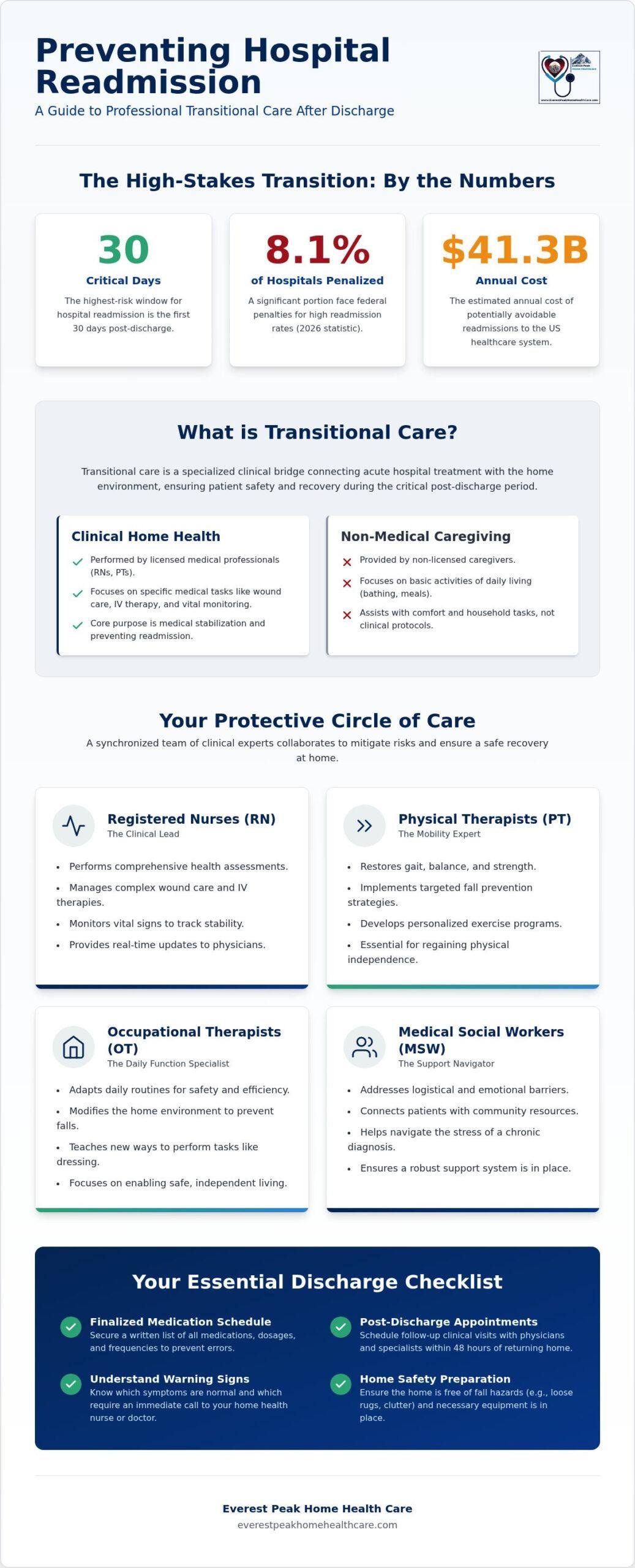
Transitional care refers to a specialized clinical bridge that connects acute hospital treatment with the home environment. This phase is defined by the “Critical 30 Days,” a high-risk window where the likelihood of returning to the hospital is at its peak. Research indicates that potentially avoidable readmissions cost the healthcare system approximately $41.3 billion annually, highlighting the urgent need for professional oversight during this time. For the patient, this period is often a confusing blur of new symptoms and complex instructions that require expert navigation.
The primary objectives of this care model are medical stabilization, patient safety, and the restoration of functional independence. Families often confuse these services with non-medical caregiving, but there’s a vital distinction. Clinical home health visits involve licensed professionals who perform specific medical tasks, whereas non-medical care focuses on basic activities of daily living. Professional intervention is the cornerstone of preventing hospital readmission at home by ensuring that complex recovery protocols are followed with precision.
The Clinical Significance of the Transition Period
Transitions are historically prone to medical errors because the information flow between hospital staff and home caregivers is often fragmented. Medication reconciliation is a primary safeguard in this process; it involves a meticulous review of pre-hospitalization drugs against new discharge orders to prevent adverse drug events. Clinical errors often occur when a patient inadvertently doubles a dosage or misses a critical contraindication. Transitional care is a multidisciplinary clinical intervention starting within 48 hours of discharge.
Identifying Patients at High Risk for Readmission
Certain clinical profiles present a higher statistical probability of complications. Triggers like Congestive Heart Failure (CHF), Chronic Obstructive Pulmonary Disease (COPD), and post-operative infections require vigilant monitoring. Beyond a physical diagnosis, factors such as cognitive decline or a lack of robust family support significantly increase vulnerability. A professional clinical assessment performed immediately after discharge allows for the identification of these risks before they escalate into a medical emergency. This proactive approach is essential for preventing hospital readmission at home for patients with complex comorbidities, particularly as hospital penalties for readmissions continue to increase in 2026.
The Multidisciplinary Team: Clinical Roles in Preventing Hospital Readmission at Home
Successful recovery depends on the synchronized expertise of a clinical team. It’s not merely an administrative hand-off. Instead, it’s an evidence-based transitional care model that utilizes specialized practitioners to mitigate medical risks. Each role is distinct yet interconnected, forming a protective circle around the patient to ensure safety during the vulnerable weeks following discharge.
- Registered Nurses (RN): These clinicians lead the care plan by performing comprehensive assessments, managing complex wound care, and monitoring vital signs to track stability.
- Physical Therapists (PT): They focus on restoring gait and balance, which is essential for preventing falls, one of the leading causes of readmission.
- Occupational Therapists (OT): These specialists adapt daily routines and the home environment to ensure the patient can perform tasks safely without overexertion.
- Medical Social Workers (MSW): They address logistical and emotional barriers, such as access to community resources or navigating the stress of a chronic diagnosis.
Skilled Nursing and Clinical Monitoring
In-home nurses act as the primary clinical eyes in the residential setting. They’re trained to detect subtle signs of clinical decline, such as fluid retention or sudden cognitive shifts, before these issues escalate into an emergency room visit. Managing complex wound care and administering IV therapies at home requires a high level of technical precision that goes beyond basic caregiving. These practitioners provide real-time updates to physicians in Los Angeles, ensuring that the medical plan remains responsive to the patient’s daily progress. This constant vigilance is a cornerstone of preventing hospital readmission at home.
Rehabilitative Therapies: Restoring Independence
Rehabilitative specialists focus on the functional aspects of recovery. Physical therapists implement specific exercise protocols for post-surgical orthopedic patients, focusing on strengthening the muscles required for safe ambulation. Occupational therapists analyze the home environment to suggest modifications that facilitate energy conservation and mastery of activities of daily living. Speech therapists play a critical role for stroke survivors by managing swallowing safety, known as dysphagia, to prevent aspiration pneumonia. These combined efforts allow patients to regain their autonomy while maintaining a high standard of clinical safety. If you’re preparing for a loved one’s discharge, our team provides the skilled nursing care and therapy services necessary to bridge the gap between hospital and home.
Home Health vs. Skilled Nursing Facilities (SNF): Making the Best Choice
Selecting the appropriate recovery environment is a pivotal step in preventing hospital readmission at home. While a Skilled Nursing Facility (SNF) offers 24-hour clinical monitoring, home health provides a model based on intermittent expert visits. The choice depends largely on the patient’s medical stability and the level of support available within the household. For many, the transition to a facility can be jarring. Recovering in a familiar setting often reduces the risk of transfer trauma and exposure to facility-acquired infections, which can complicate the healing process.
Financial considerations also play a role in this decision. In 2026, the national median cost for a semi-private room in an SNF is approximately $9,581 per month. Additionally, Medicare beneficiaries face a daily co-pay of $217.00 for days 21-100. Home-based clinical care is often covered by Medicare Part B for those who meet the homebound criteria, making it a financially sustainable path for long-term recovery without the high overhead of institutional living.
When is Home Health the Superior Clinical Option?
Home health is the preferred choice when a patient is medically stable but remains homebound, meaning leaving the residence requires a taxing effort. Recovering in a low-stress, infection-controlled personal environment allows the clinical team to focus on functional goals within the patient’s actual living space. At Everest Peak, we bridge the gap for patients in North Hollywood and the San Fernando Valley by providing professional nursing and therapy visits that integrate into the family’s daily life. This personalized oversight is instrumental in preventing hospital readmission at home because it allows for real-world adjustments to the care plan.
Recognizing the Limitations of Home-Based Care
There are instances where 24-hour medical supervision in a facility is clinically necessary, particularly for patients with unstable vital signs or those requiring intensive respiratory support. In these cases, a staged recovery approach is often best. A patient might start their journey in an SNF and transition to home health once they no longer require round-the-clock monitoring. We should clarify that Everest Peak provides scheduled clinical visits from licensed professionals; we don’t offer 24/7 live-in care. Our role is to act as a disciplined clinical partner, supporting the family through expert interventions during the most critical hours of the recovery process.
Discharge Checklist: Preventing Hospital Readmission
Transitioning from a clinical facility to a residential setting requires a disciplined, step-by-step methodology. Actionable planning is the most effective tool for families focused on preventing hospital readmission at home. By organizing the environment and medical data before the patient arrives, you mitigate the chaos that often leads to clinical errors. Use the following framework to secure the recovery environment.
- Step 1: Secure Documentation. Obtain a finalized discharge summary and a reconciled medication schedule. This document is the source of truth for all follow-up care and prevents dangerous prescription overlaps.
- Step 2: Initiate Clinical Visits. Schedule the first nursing or therapy assessment to occur within 48 hours of arrival. Early intervention identifies complications before they require emergency care.
- Step 3: Audit for Safety. Remove environmental hazards like loose rugs and improve lighting in high-traffic areas to reduce fall risks.
- Step 4: Establish a Care Station. Designate a central location for medical records, daily vitals logs, and wound care supplies to ensure all caregivers have immediate access to vital information.
The Discharge Planning Meeting
Before leaving the hospital, request a formal meeting with the social worker or discharge planner. Ask specific questions about the frequency of follow-up appointments and the specific clinical criteria for contacting the physician. It’s vital to confirm that necessary medical equipment, such as walkers or CPAP machines, is scheduled for delivery before the patient’s arrival. Ensuring the primary caregiver fully understands the recovery plan is a prerequisite for a safe transition. If you need assistance coordinating these clinical needs, schedule a post-operative care assessment to ensure every detail is managed professionally.
Home Safety and Environment Modifications
Environmental factors are a leading contributor to recovery setbacks. Eliminating trip hazards, such as throw rugs and cluttered walkways, is an immediate priority. Improving bathroom accessibility with grab bars and ensuring adequate lighting in hallways can prevent the falls that frequently result in re-hospitalization. An Occupational Therapist provides professional recommendations for these modifications, tailoring the environment to the patient’s specific mobility levels. A safe and adapted home environment directly correlates with lower readmission rates and improved patient autonomy. This proactive environmental management is a key component of preventing hospital readmission at home for patients with limited mobility.
Professional Transitional Care in North Hollywood: The Everest Peak Approach
Everest Peak Home Health Care operates with a philosophy of quiet confidence, serving as a protective extension of the family’s care circle during the vulnerable post-hospitalization phase. Our approach to preventing hospital readmission at home is rooted in clinical excellence and rigorous coordination with major medical centers across the San Fernando Valley. By facilitating seamless patient hand-offs from acute care facilities to the residential setting, we ensure that the recovery momentum established in the hospital isn’t lost. Our local, multidisciplinary team deeply understands California healthcare standards and the specific needs of the North Hollywood community, providing a stabilizing force for families during stressful transitions. We don’t just provide visits; we provide a structured path through the complexities of home-based medical care.
Tailored Care Plans for Diverse Recovery Needs
Every recovery journey is unique, requiring a customized clinical strategy that addresses specific post-operative or chronic condition management goals. We develop individualized nursing and therapy schedules that prioritize patient dignity and autonomy while maintaining strict medical oversight. This personalized attention ensures that interventions, such as medication reconciliation and wound care, are adapted to the patient’s home life without compromising safety. Professional empathy is at the core of our interactions, acknowledging the challenges of aging and recovery without becoming overly sentimental. Initiating clinical home health services with Everest Peak is a straightforward process that begins with a professional assessment to align our resources with the physician’s discharge orders. Our goal is to empower patients to regain their independence through specialized rehabilitative support that respects their individual pace of healing.
Serving the North Hollywood and San Fernando Valley Communities
Our presence in North Hollywood allows us to act as a dependable partner for families throughout the Greater Los Angeles area. We provide licensed, professional oversight in the residential setting, bridging the gap between facility care and complete independence. As of 2026, it’s important for families to verify specific Medicare Part B coverage details for Transitional Care Management visits, as these professional visits are critical for maintaining clinical stability. By choosing a local team, you benefit from practitioners who are familiar with the regional medical network and can coordinate quickly with your primary care physicians. This level of disciplined, professional care is essential for preventing hospital readmission at home and ensuring a safe, lasting recovery for your loved ones. Our team remains observant and deeply respectful, positioning ourselves as a professional extension of your family’s support system.
Contact Everest Peak today to discuss your transitional care needs.
Securing a Stable Path to Recovery
Navigating the weeks following a hospital discharge requires more than just patience; it demands a disciplined clinical strategy. We’ve explored how the first 30 days represent a high-risk window for complications and why a multidisciplinary team is essential for maintaining patient safety. By integrating skilled nursing care with specialized rehabilitative therapies, families can create a stable environment that prioritizes long-term health. Successfully preventing hospital readmission at home is achieved through early clinical intervention, meticulous medication reconciliation, and professional home safety audits.
At Everest Peak Home Health Care, our licensed Registered Nurses and specialized therapists act as a protective extension of your family circle. We focus on providing the clinical excellence and professional empathy needed to support patients throughout North Hollywood and the San Fernando Valley. You don’t have to manage these medical complexities alone. Our team is here to provide the steady guidance and expert oversight required for a safe return to independent living.
Secure a professional home health assessment for your loved one today. We look forward to supporting your family through a successful and stable recovery.
Frequently Asked Questions
What is the most important thing to do on the first day after hospital discharge?
The most critical action on the first day is ensuring the patient has a reconciled medication list and a scheduled clinical assessment. You should verify that all new prescriptions are filled and that any conflicting medications from before the hospital stay are set aside. Scheduling a visit from a licensed professional within the first 48 hours is a key step in preventing hospital readmission at home, as it allows for an immediate baseline evaluation of the patient’s stability.
Does Medicare Part B cover transitional care and clinical home health visits?
Medicare Part B typically covers Transitional Care Management services and clinical home health visits for eligible beneficiaries who are considered homebound. To qualify, a physician must certify that the patient requires intermittent skilled nursing or therapy services. It’s important to verify current 2026 coverage specifics, as these services involve a coordinated effort between your primary doctor and the home health agency to ensure a safe transition from the hospital to the residential setting.
How often will a nurse or therapist visit my home during the first 30 days?
The frequency of visits from a Registered Nurse or therapist is determined by the physician’s specific plan of care. In many cases, a patient may receive two to three visits per week during the initial high-risk period of recovery. These scheduled visits focus on monitoring vital signs, managing complex wounds, or performing rehabilitative exercises. The intensity of care typically decreases as the patient achieves medical stability and regains their functional independence within the home environment.
What is the difference between clinical home health and a non-medical caregiver?
Clinical home health involves licensed medical professionals, such as Registered Nurses and Physical Therapists, who perform medical tasks like wound care and gait training. In contrast, a non-medical caregiver or personal care assistant provides support with activities of daily living, such as hygiene, grooming, and light meal preparation. While both roles are important, only clinical visits provide the professional medical oversight necessary for managing complex health conditions and preventing hospital readmission at home.
How do I know if my loved one is eligible for skilled nursing at home?
Eligibility for skilled nursing at home is primarily based on three criteria: the patient must be under a physician’s care, require intermittent skilled services, and be considered homebound. A person is homebound if leaving the residence requires a taxing effort or the assistance of another individual. A licensed professional from Everest Peak can perform an initial assessment to determine if these clinical requirements are met and coordinate with your doctor to establish a formal care plan.
What happens if a patient’s condition declines during home-based recovery?
If a patient’s condition shows signs of decline, the visiting clinician immediately notifies the attending physician to adjust the treatment plan. This proactive monitoring allows for early interventions, such as medication changes or laboratory tests, which can often be managed within the home. However, if the decline is significant and poses an immediate safety risk, the clinical team will coordinate a transfer to a higher level of care, such as an acute hospital or specialized facility.
Can Everest Peak help with medication reconciliation after discharge?
Yes, medication reconciliation is a fundamental component of the initial assessment performed by our Registered Nurses. During the first visit, the nurse will compare pre-hospitalization medications with the new discharge orders to identify any potential drug interactions or dosage errors. This meticulous review is a critical safeguard in the recovery process, ensuring that the patient follows a safe and accurate pharmacological regimen as they transition back to their domestic routine and independent living.
How do I start transitional care services in the North Hollywood area?
To initiate transitional care services in the North Hollywood or San Fernando Valley area, you can contact Everest Peak Home Health Care directly to discuss your specific needs. Our team will coordinate with your hospital discharge planner or primary care physician to obtain the necessary medical orders. Once the referral is received, we will schedule a comprehensive clinical assessment to begin the recovery process and establish a professional support system for your family’s unique situation.