

A change in balance, a recent hospital stay, or growing difficulty with daily routines can leave a family asking the same question: what kind of elderly care at home in Los Angeles is right for someone they love? The answer depends on the support they need now, the care they may need as circumstances change, and what helps them feel safe and respected at home.
It’s understandable to feel uncertain about the difference between personal care assistance and skilled home health services. Both can support life at home, but they address different needs. A thoughtful plan considers the older adult’s preferences, daily routine, home environment, family support, and possible public assistance or payment options.
This guide explains common types of in-home support, how to match them to changing needs, and practical steps families can take to plan care. You’ll also learn how skilled nursing, rehabilitation therapies, personal care assistance, and medical social services can contribute to an individualized plan. Based in North Hollywood and serving the surrounding Los Angeles area, Everest Peak Home Health Care provides clinical and personal support to help older adults maintain dignity and independence at home.
Key Takeaways
- Elderly care at home in Los Angeles can involve daily assistance, clinical care, rehabilitation, or a combination shaped around the older adult’s needs.
- Personal care and home health serve different purposes. Understanding the distinction can help families identify the right type of support.
- Start planning by discussing the older adult’s priorities, daily routine, mobility concerns, and any clinical instructions.
- IHSS may be one resource to explore. Check current eligibility and application details directly with Los Angeles County DPSS.
- Everest Peak Home Health Care’s nursing, therapy, medical social services, and personal care assistance can support individualized care at home.
What Elderly Care at Home in Los Angeles Can Include
Elderly care at home is support provided in an older adult’s residence to help with daily activities, health needs, rehabilitation, or a combination of these, while supporting comfort and independence at home.
The phrase covers a range of services, not one fixed care arrangement. As a general overview, Home care can include assistance delivered in a person’s home rather than an institutional setting. Families searching for “elderly care at home Los Angeles” may find both personal assistance and clinical home health, so distinguishing their purposes is a useful first step. The search phrase describes a broad need, not a single type of service.
Home is a setting for planned support, not a substitute for emergency response. If a person has sudden, severe symptoms or is in immediate danger, call 911 rather than waiting for a scheduled home visit. To focus a search for “elderly care at home Los Angeles” options, first identify whether the main need is daily assistance, clinical care, or rehabilitation.
Everyday assistance and support with daily activities
Personal care assistance can help with grooming, hygiene, dressing, and other everyday routines. The right support respects the older adult’s preferences and allows them to do as much as they safely can, with help for the tasks that have become difficult. This assistance focuses on daily living; it is distinct from clinical assessment or treatment by a health professional.
Before arranging support, list the specific tasks that are difficult and when help is needed. Discuss how the older adult prefers to receive assistance, including their preferences for privacy and timing. This can make care more respectful and less disruptive to familiar routines.
Clinical home health and rehabilitation
Clinical services address health or rehabilitation needs in the home. Skilled nursing supports clinical care, while physical therapy can focus on movement and mobility, occupational therapy on daily function, and speech therapy on communication or swallowing needs. The appropriate services depend on the person’s situation and care plan.
These services differ from personal assistance because they involve clinical or therapeutic care delivered by health professionals. To learn more about nursing, read the skilled nursing care guide. Some older adults need one type of support; others benefit from personal and clinical services working together.
Home Care vs. Home Health: Understanding the Difference
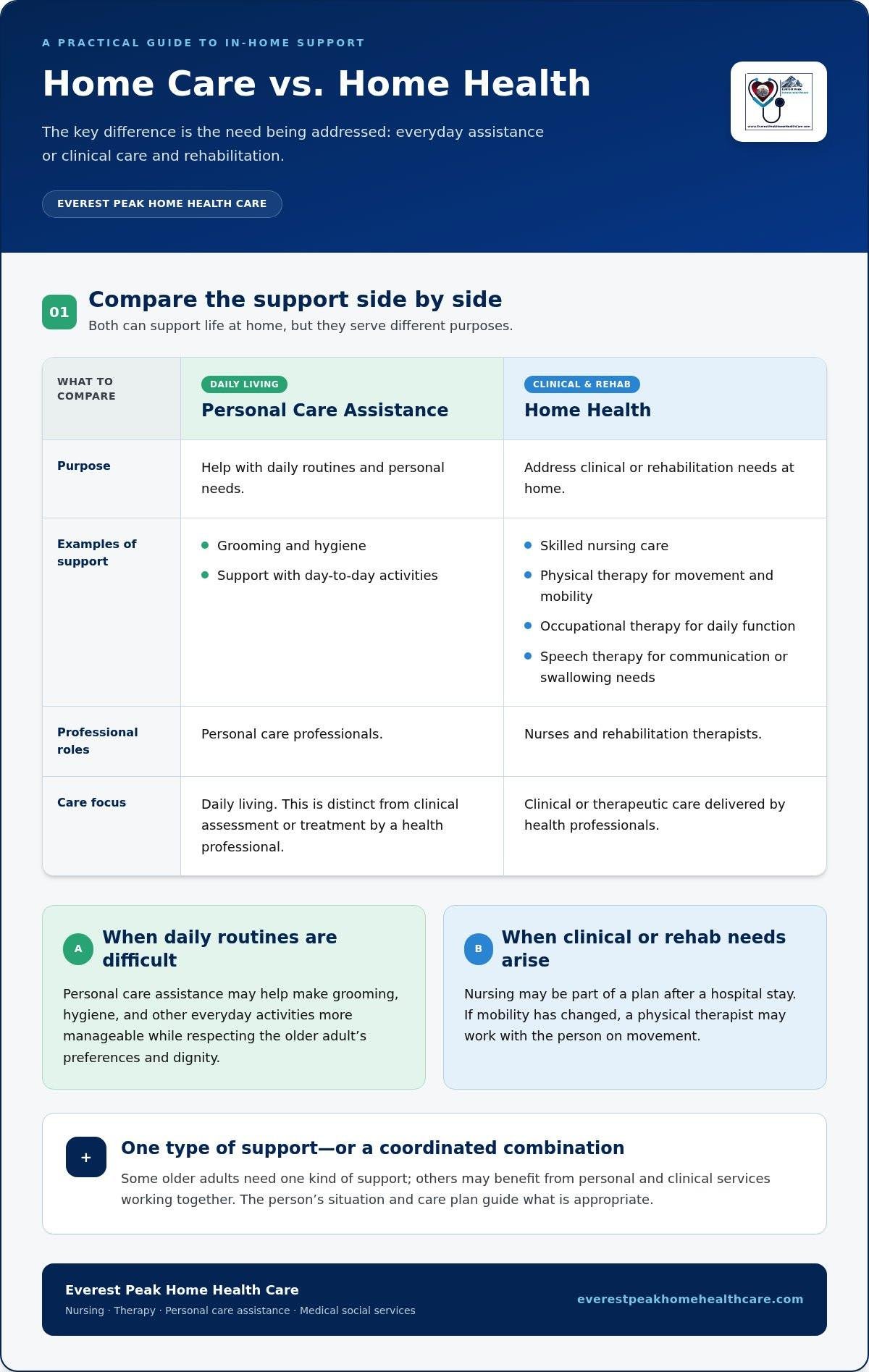
Families comparing elderly care at home in Los Angeles may see “home care” and “home health” used in overlapping ways. The practical distinction is the need being addressed: personal assistance supports everyday living, while home health involves clinical care or rehabilitation provided by health professionals. An older adult may need one kind of support or a coordinated combination, depending on their circumstances and care plan.
| Category | Purpose | Typical support | Professional roles |
|---|---|---|---|
| Personal care assistance | Help with daily routines and personal needs | Grooming, hygiene, and support with day-to-day activities | Personal care professionals |
| Home health | Address clinical or rehabilitation needs at home | Nursing care and therapies, such as physical or occupational therapy | Nurses and rehabilitation therapists |
When the main need is help with daily living
If an older adult needs support with grooming, hygiene, or other daily routines, personal care assistance may make those activities more manageable. Respectful help can preserve comfort and dignity while allowing the person to participate in familiar routines as much as they can. Everest Peak Home Health Care provides personal care assistance for daily routines and personal needs.
When nursing or therapy may be part of the plan
A nurse may provide skilled clinical care, while rehabilitation therapists address function and recovery needs. For example, after a hospital stay, a person may need nursing care; if their mobility has changed, a physical therapist may work with them on movement as part of their care. These examples don’t mean a particular service is right for everyone. The person’s needs and clinical plan guide what’s appropriate. Learn more about in-home physical therapy.
Support can also involve coordination across roles. Based in North Hollywood and serving the surrounding Los Angeles area, Everest Peak Home Health Care provides nursing, therapy, personal care assistance, and medical social services as part of individualized care planning. Families exploring local programs can review Los Angeles County Older Adult Services for information about county resources. Visit Everest Peak Home Health Care to learn about its services.
How to Match At-Home Elderly Care to Your Family’s Needs
A useful care plan starts with the older adult, not a list of services. For families exploring elderly care at home Los Angeles options, a clear picture of the person’s priorities, routines, and current challenges can help distinguish everyday assistance from clinical or rehabilitation needs.
Start with the person, daily routine, and home environment
Invite the older adult to describe what matters most and where they would welcome help. Write down what they manage independently and what has become difficult. Include mobility, communication, personal routines, and the home environment in the discussion. Preferences about privacy, timing, and how assistance is offered can help keep support respectful and familiar.
Use this checklist to guide a family conversation:
- Priorities: What routines or activities does the older adult want to maintain?
- Daily support: Which tasks, such as grooming or hygiene, require help, and when?
- Mobility and safety: Are there concerns moving around the home or completing everyday activities?
- Communication: What makes it easier for the person to understand information and express needs?
- Clinical guidance: What instructions from health professionals should be part of the plan?
- Family capacity: Which forms of support can relatives provide consistently, and where are the gaps?
Coordinate clinical needs and family support
Family members often notice changes in routines, movement, or comfort that are useful to share with the care team. Describe observations specifically, such as which activity has become harder or what has changed since a hospital stay. Share relevant clinical instructions with the professionals involved, and clarify who is responsible for each part of the plan.
Nurses provide skilled nursing care; physical, occupational, and speech therapists address distinct rehabilitation needs; and medical social services can help families consider care-related concerns and resources. Personal care assistance supports daily activities rather than replacing clinical assessment or treatment. Understanding these roles helps families plan for elderly care at home in Los Angeles in a practical, individualized way.
Needs can shift as health, mobility, or family circumstances change. Revisit the plan when a routine becomes harder, new clinical instructions are provided, or the current support no longer fits. The care team can help families consider how nursing, therapy, medical social services, and personal support may work together while respecting the older adult’s preferences.
If symptoms are sudden or severe, or the person is in immediate danger, seek emergency care rather than waiting for a routine home visit. For non-emergency planning, use the checklist to organize questions and share a clear account of the older adult’s needs.
Los Angeles Resources for Planning Home Care
Public assistance may be one part of a broader plan for elderly care at home in Los Angeles. Los Angeles County’s Department of Public Social Services (DPSS) administers In-Home Supportive Services (IHSS), a program that may help eligible people receive assistance to remain safely at home. IHSS is one possible resource, not a substitute for assessing the older adult’s full daily, clinical, and family support needs.
Understanding IHSS as a Los Angeles County resource
Eligibility, authorized services, and application steps depend on current program rules and an individual assessment. Families should review the latest IHSS eligibility criteria, application requirements, and program details directly with Los Angeles County DPSS. Applying does not guarantee approval, and IHSS may not pay for every type of service. Treat it as one option to investigate alongside other care-planning considerations.
Preparing for a care-planning conversation
A little preparation can help relatives describe the older adult’s needs clearly and identify where professional support may fit. Before a conversation with family members or the care team, gather:
- Daily routine: Note activities the older adult manages independently and where assistance is needed.
- Observed changes: Record concerns about mobility, communication, comfort, or completing familiar tasks.
- Clinical instructions: Bring relevant discharge notes or treatment instructions so the discussion reflects current guidance.
- Care goals: Identify what the older adult wants to maintain and what kind of help they’re comfortable receiving.
- Questions about coordination: Clarify which needs involve family support, personal assistance, nursing, therapy, or community resources.
These notes can help distinguish routine daily support from clinical needs and make it easier to discuss how different forms of help might work together. Include the older adult in the conversation wherever possible; their preferences are an important part of a respectful plan.
For families in North Hollywood and the surrounding Los Angeles area, Everest Peak Home Health Care provides nursing, therapy, medical social services, and personal care assistance to address different needs at home. Public resources and professional care can play complementary roles, while each family’s plan should reflect the person’s circumstances and current guidance. Explore home health care support as you consider next steps.
How Everest Peak Home Health Care Supports Older Adults at Home
For families considering elderly care at home in Los Angeles, knowing who may contribute to a care plan can make the next conversation more focused. Based in North Hollywood and serving the surrounding Los Angeles area, Everest Peak Home Health Care brings clinical and personal support together around the older adult’s needs and preferences.
A multidisciplinary team for care at home
The team includes registered nurses, vocational nurses, physical therapists, occupational therapists, speech therapists, and medical social workers. Each role brings a different perspective to care, helping families consider clinical, functional, communication, and social needs in the home setting.
- Registered and vocational nurses provide nursing support as part of an individual’s clinical care.
- Physical therapists address movement and mobility needs, while occupational therapists focus on function in everyday activities.
- Speech therapists address communication and other speech-related needs.
- Medical social workers contribute support around social and care-planning concerns.
- Personal care assistance helps with daily routines and personal needs, complementing clinical care when appropriate.
The specific mix of support depends on the person’s circumstances. A family may be managing recovery needs, changes in daily function, or a need for respectful help with personal routines. The aim is to consider each need clearly while honoring the older adult’s voice, dignity, and independence.
Taking the next step with a local care team
Before discussing care, write down what the older adult wants to preserve in their routine, which activities are becoming difficult, and what support family members can provide. Include relevant clinical instructions and questions about how nursing, therapy, personal assistance, or medical social services might relate to the situation. A clear description of priorities gives the conversation a practical starting point without assuming one service or outcome will fit everyone.
Care planning can feel more manageable when families take it one question at a time. Include the older adult wherever possible and let their preferences guide the discussion. Everest Peak Home Health Care works with families in the surrounding Los Angeles area to address home health and personal care needs.
Connect with Everest Peak Home Health Care to discuss your family’s care needs and possible next steps.
Take the Next Step Toward Thoughtful Home Care
Choosing elderly care at home in Los Angeles starts with understanding what the older adult wants to maintain and where support would make daily life safer or more manageable. Personal care assistance, skilled nursing, and rehabilitation therapies address different needs, and some families may consider a combination as circumstances change. Local public resources such as IHSS may also be worth exploring. Verify current eligibility and program details directly through DPSS.
Everest Peak Home Health Care is based in North Hollywood and serves the surrounding Los Angeles area. Its team includes licensed nursing professionals and physical, occupational, and speech therapists, and provides skilled nursing, therapy, medical social services, and personal care assistance. Sharing priorities, daily routines, and relevant clinical needs can help begin a clear conversation about possible next steps.
Connect with Everest Peak Home Health Care to discuss your care needs with a local team. With the older adult’s preferences at the center, families can move forward one informed decision at a time.
Frequently Asked Questions
What does elderly care at home in Los Angeles include?
Elderly care at home in Los Angeles can include personal assistance, clinical care, rehabilitation, or a combination based on the older adult’s needs. Personal care assistance may help with grooming, hygiene, and daily routines. Home health services can include skilled nursing and physical, occupational, or speech therapy. Start by noting which tasks the person handles independently, what support they prefer, and whether there are clinical instructions to consider.
What is the difference between home care and home health care?
Home care commonly refers to non-clinical help with daily living, while home health care involves clinical or rehabilitative support from health professionals. Personal assistance can support grooming and hygiene; a nurse or therapist addresses clinical or rehabilitation needs. These forms of support are distinct, though an older adult may need one or both. The appropriate plan depends on the person’s circumstances, preferences, and clinical needs.
Can IHSS help pay for elderly care at home in Los Angeles?
IHSS may help eligible people receive assistance that supports remaining safely at home, but approval and authorized services depend on current program rules and an individual assessment. It doesn’t guarantee payment for every type of care. Los Angeles County DPSS administers IHSS, so families should verify current eligibility, application requirements, and program details directly with DPSS before making financial plans around the program.
How much does elderly care at home cost in Los Angeles?
The cost of elderly care at home varies with the type of support, the person’s needs, and the care arrangement. Everest Peak Home Health Care charges per visit for clinical nursing and therapy services and by the hour for personal care assistance. Clarify which support is being considered and how often it may be needed when discussing care and fees. Don’t assume a public program or insurance will cover a specific service.
Can older adults receive nursing and therapy at home?
Yes. Home-based support can include skilled nursing and rehabilitation therapies, depending on the older adult’s needs and care plan. Everest Peak Home Health Care serves the surrounding Los Angeles area with registered and vocational nurses, physical therapists, occupational therapists, and speech therapists. Nursing and each therapy address distinct needs; the care team can discuss how those roles relate to the person’s situation without promising a particular outcome.
How can I make an older adult’s home safer for care?
Begin by walking through the home with the older adult and noticing obstacles along the routes they use most. Keep walkways clear, improve lighting in commonly used areas, and note places where balance or transfers feel difficult. Discuss concerns about stairs, bathroom routines, and mobility with the person’s care team. Any changes should reflect the older adult’s abilities and preferences, while urgent hazards or emergencies call for prompt appropriate help.