

What needs to be in place before a loved one leaves the hospital, and who will help once they’re home? The move can bring relief, but it also raises practical questions about medications, follow-up visits, home safety, and daily support. A safe transition depends on matching recovery needs with the right level of care, not simply arranging help as quickly as possible. For families transitioning from hospital to home care Los Angeles, having a clear plan can make the next steps feel more manageable.
It’s understandable to feel uncertain about what must be arranged before discharge or whether skilled home health or nonmedical personal care is the better fit. This guide explains what to clarify with the hospital team, how these care options differ, and how to prepare the home and coordinate family responsibilities. You’ll also learn what to include in a written recovery plan, from medication instructions and follow-up appointments to whom to contact if symptoms or care needs change.
Key Takeaways
- For transitioning from hospital to home care Los Angeles, begin by confirming discharge instructions, follow-up appointments, and who to contact with questions.
- Request an up-to-date medication list and ask the clinical team to clarify any discrepancies before leaving the hospital.
- Compare skilled home health, personal care, and facility recovery by the type of support needed, who provides it, and where it takes place.
- Prepare the home and create a shared list for medications, appointments, care visits, and family check-ins during the first week.
- Everest Peak Home Health Care provides nursing, therapy, medical social services, and personal care assistance to support recovery plans at home.
Transitioning from hospital to home care in Los Angeles: what happens next?
Leaving the hospital can feel overwhelming, even when a patient is ready to go home. Families may be relieved and still unsure about what comes next: which instructions matter most, who will arrange follow-up, and whether extra support is needed. Transitioning from hospital to home care Los Angeles means coordinating the move from inpatient treatment to an appropriate recovery setting, with clear responsibilities for the patient, family, and care team.
The right support depends on the person’s clinical needs and care recommendations. Not everyone leaving the hospital needs professional services at home; some people can recover with family support and outpatient follow-up. When additional help is recommended, distinguish between these options:
- Skilled home health: Clinical visits, such as nursing or therapy, provided according to the patient’s care needs and recommendations.
- Personal care: Nonmedical assistance with everyday activities, rather than skilled clinical treatment.
- Hospice: A distinct type of care for people with serious illness whose needs and goals call for hospice support.
- Emergency care: Urgent assessment and treatment for a medical emergency, not routine home visits or personal assistance.
In brief: Skilled home health provides clinical nursing or therapy visits, while nonmedical personal care helps with daily activities at home. The broader idea of home care includes support delivered in a person’s residence, but the specific services and purpose can differ. Use the discharge recommendations to identify which type of care the patient needs, rather than assuming one type includes another.
What does hospital-to-home care mean?
The transition includes more than arranging a ride home. The hospital team should communicate follow-up instructions, medication information, and precautions to follow during recovery. Ask for explanations in language the patient and family understand, and write down anything that needs clarification. The plan may involve professional visits, family assistance, outpatient care, or a combination, depending on the patient’s clinical needs and recovery recommendations.
Who helps coordinate a Los Angeles discharge?
The patient and family caregiver can work with the hospital discharge planner and the clinicians who will provide outpatient follow-up. Before leaving, ask who is responsible for each next step: scheduling appointments, sharing records, answering medication questions, or arranging home care. Everest Peak Home Health Care is based in North Hollywood and serves the surrounding Los Angeles area, providing skilled nursing, therapy, medical social services, and personal care assistance.
A useful handoff is specific: know whom to call for routine questions, whom to contact about changing care needs, and where to seek emergency help. Writing down names, phone numbers, and each person’s role can reduce uncertainty once the patient is home.
Preparing for Hospital-to-Home Handoff in Los Angeles
A little preparation before discharge can make the first days at home less uncertain. During the handoff, focus on what the patient needs to do, who will help, and where to turn when questions arise. The Agency for Healthcare Research and Quality’s IDEAL Discharge Planning resource offers a framework for involving patients and families in preparing for a safe transition.
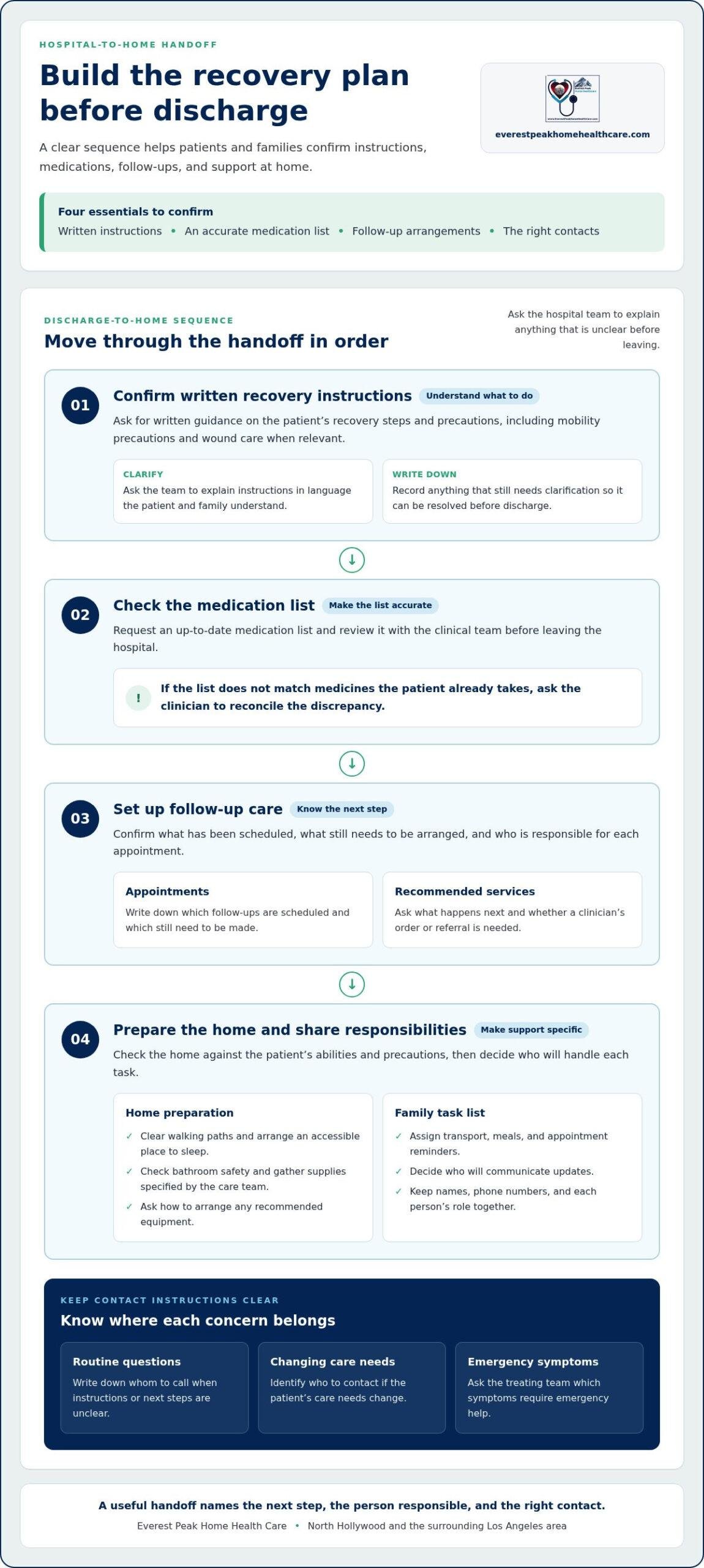
Before leaving the hospital, confirm four essentials: clear written instructions, an accurate medication list, follow-up arrangements, and the right contacts for questions or changing symptoms. Use this checklist to organize the handoff:
- Confirm instructions. Ask for written guidance on mobility precautions, wound care, and other recovery steps. Request a current medication list, and ask the clinician to reconcile discrepancies between it and the medicines the patient already takes.
- Arrange follow-ups. Confirm which appointments are scheduled, which still need to be made, and who is responsible for arranging them. If home health or another service is recommended, ask what the next step is and whether a clinician’s order or referral is needed.
- Prepare the home. Clear walking paths, arrange an accessible place to sleep, check bathroom safety, and gather the supplies specified by the care team. If equipment is recommended, ask what is needed and how the family should arrange it.
- Clarify contacts and responsibilities. Write down whom to call with routine questions, who to contact about care changes, and what symptoms require emergency help. Assign family members specific tasks, such as transport, meals, appointment reminders, or communicating updates.
Questions to ask the hospital team before discharge
Ask the treating team to explain which symptoms should prompt a call to a clinician and which require emergency help. Confirm that instructions are written down, follow-up appointments are clear, and you know whom to contact if something is unclear after the patient gets home. If a service has been recommended, ask what happens next and who will coordinate that step.
Prepare the home and family support plan
Walk through the home with the patient’s current abilities and precautions in mind. Check that essential items are reachable and that family members understand who will handle each task. For surgery-specific recovery context, see this post-operative care guide for North Hollywood.
Everest Peak Home Health Care serves the surrounding Los Angeles area from North Hollywood. Its skilled nursing, therapy, and personal care assistance can be part of a clinician-directed recovery plan, with each service matched to the patient’s needs and recommendations.
Home health, personal care, or facility recovery: how to compare options
Choosing a recovery setting starts with the patient’s assessed needs, preferences, and the support available at home. Skilled home health, personal care assistance, and facility-based rehabilitation serve different purposes, so ask the discharge team which needs each option would address. No setting is universally safer or better for every patient.
| Option | Purpose and typical support | Provider type and setting | Questions to verify |
|---|---|---|---|
| Skilled home health | Clinical nursing or therapy for specific health or rehabilitation needs | Nursing or therapy professionals provide visits in the home | Which services are recommended? Is an order or referral needed? How will visits fit the care plan? |
| Personal care assistance | Nonmedical help with daily activities | Personal care provider in the home | Which daily tasks need support, and how often is help needed? |
| Facility-based rehabilitation | Recovery support in a facility, as recommended by the clinical team | Facility-based care setting | Would this setting address the patient’s needs? What services and arrangements should the family discuss? |
As you compare options for transitioning from hospital to home care Los Angeles, separate clinical treatment from practical daily support. A person who needs nursing assessment or rehabilitation therapy may have different needs from someone who mainly needs help with routine activities. Some patients may need a facility-based option; discuss the level of support and supervision required with the discharge team rather than assuming home is the right fit.
When skilled home health may fit the recovery plan
Skilled nursing and therapy address specific clinical or rehabilitation needs through professional services in the home, when recommended for the patient. Everest Peak Home Health Care provides skilled nursing, physical therapy, occupational therapy, and speech therapy. The services in an individual plan should reflect the patient’s needs and clinical recommendations. For more detail, see the skilled nursing care guide.
When personal assistance or another setting may be needed
Personal care assistance supports daily activities; it isn’t emergency medical care or a substitute for skilled nursing. If the patient needs frequent supervision or has safety concerns that family members can’t manage, raise those needs with the discharge team and ask whether another setting should be considered. When planning personal care, identify the daily tasks that require help and how they fit into the patient’s overall recovery plan.
A practical first-week plan after discharge to home in Los Angeles
The first week at home is easier to manage when everyone works from the same written plan. Keep the discharge instructions where the patient and caregivers can find them, and use them to guide medication routines, follow-up appointments, recommended care visits, and family check-ins. The exact schedule should follow the treating clinician’s directions, not a one-size-fits-all timetable.
Create one shared list for medications and appointments, and update it with the care team when instructions change. Include medication names and directions as provided, appointment dates and locations, planned nursing or therapy visits, and the contact for questions. A shared paper record or digital document can help prevent family members from relying on different versions of the plan.
Track visits, medications, and recovery questions
Use a simple log to record when visits are scheduled, what instructions the patient receives, and which questions still need answers. Note who coordinates nursing, therapy, primary-care, and specialist follow-ups; responsibilities may involve different clinicians. Write down changes or concerns in plain language, including when they began, then share that record with the appropriate clinician. The medical social services family guide offers additional context for families coordinating care needs.
- At each check-in: Review the next appointment or care visit and identify who will help the patient get there or prepare for it.
- As questions arise: Add them to the log rather than relying on memory, then raise them with the clinician responsible for that issue.
- If symptoms or needs change: Follow the discharge instructions for whom to contact. For urgent concerns, use the instructions’ emergency guidance or contact emergency services. Don’t use a home care visit as a substitute for emergency help.
Adjust the plan when needs or circumstances change
A recovery plan may need to be revisited if the patient’s abilities, support at home, or care needs differ from what was expected. Contact the responsible clinician to discuss the change and ask whether the instructions or services should be reviewed. If a scheduled home health visit is missed or a scheduling concern arises, contact the agency directly to report it and discuss next steps.
Everest Peak Home Health Care provides skilled nursing, therapy, medical social services, and personal care assistance for patients in the surrounding Los Angeles area. The care plan should reflect the patient’s individual needs and clinical recommendations. Contact Everest Peak to discuss recovery support options.
How Everest Peak supports hospital-to-home recovery in Los Angeles
After the discharge team has outlined the recovery plan, families can arrange in-home services that help carry it forward. Everest Peak Home Health Care is based in North Hollywood and serves the surrounding Los Angeles area. Its team includes registered and vocational nurses, physical, occupational, and speech therapists, and medical social workers. Services include skilled nursing, rehabilitation therapies, medical social services, personal care assistance, and post-operative care.
These services address different needs. Nursing supports a clinician-directed plan requiring skilled care, while physical, occupational, or speech therapy may be relevant to specific rehabilitation goals. Medical social services and personal care assistance provide other forms of support. The appropriate combination depends on the patient’s needs and recommendations. Not every patient will need every service.
What to ask a home health agency before starting
Use the discharge plan as a reference when speaking with a provider. Ask which professionals will provide the recommended services, how visits are coordinated, and what information or referral steps are needed. Discuss how the proposed visit schedule fits the care plan and how to raise questions about care. Ask about payment arrangements directly, then compare the information with the hospital team’s instructions.
- Which services match the clinician’s recommendations?
- What are the referral steps and any applicable eligibility requirements?
- How will the family coordinate visits and direct questions to the right person?
Discuss a suitable home-care plan with Everest Peak
Before reaching out, gather the expected discharge date, the home address or neighborhood, current written instructions, and the kind of support being considered. This information helps the agency discuss how its services fit the recovery plan. Families transitioning from hospital to home care Los Angeles can use these details to make a focused plan for care at home.
For a calm next step, contact Everest Peak about home health services to discuss location, service scope, scheduling, referral steps, and payment questions. The conversation can help clarify care arrangements, while the treating clinician remains the resource for medical instructions and changes to the recovery plan.
Move forward with a clear, coordinated recovery plan
Transitioning from hospital to home care Los Angeles is easier to approach when the discharge instructions, follow-up responsibilities, and home support plan are clear. Compare skilled nursing and rehabilitation visits with personal care assistance, and choose based on the patient’s assessed needs rather than assuming one option suits everyone. A shared list of medications, appointments, and care contacts can help the family stay aligned as recovery begins.
Everest Peak Home Health Care is based in North Hollywood and serves the surrounding Los Angeles area. Its team includes licensed nursing and therapy professionals, with services spanning skilled nursing, rehabilitation therapies, medical social services, and personal care assistance. The right combination depends on the patient’s needs and clinical recommendations.
Discuss your family’s home health needs with Everest Peak and plan the next steps for care at home. With a practical plan and the right people informed, your family can approach the transition with greater confidence and support.
Frequently Asked Questions
What does transitioning from hospital to home care involve?
It involves coordinating the move from inpatient treatment to an appropriate recovery setting, with clear instructions and follow-up responsibilities. Before leaving, confirm the medication list, precautions, appointments, and whom to contact with questions or changing needs. The plan may include home health visits, nonmedical personal care, family support, outpatient follow-up, or another setting. Not everyone needs professional home care; the right arrangement depends on the patient’s clinical needs and recommendations.
How do I arrange home health care after a hospital stay in Los Angeles?
Start by asking the hospital discharge planner or treating clinician whether home health has been recommended and what referral steps apply. Everest Peak Home Health Care serves the surrounding Los Angeles area from North Hollywood and provides skilled nursing, therapy, medical social services, and personal care assistance. Use the discharge plan to identify the services needed and coordinate the referral and schedule.
What is the difference between home health and personal care after discharge?
Home health involves skilled clinical services, such as nursing or physical, occupational, or speech therapy, when these are appropriate to the patient’s recovery plan. Personal care assistance is nonmedical support with daily activities. The two serve different needs and shouldn’t be treated as interchangeable. Ask the discharge team which type of support is recommended, then match the care plan to the patient’s needs and daily routines.
Can a patient go home from the hospital without a caregiver?
Possibly, but the answer depends on the patient’s abilities, safety needs, home environment, and clinical recommendations. Ask the discharge team what tasks the patient can manage independently and whether supervision or help is needed with mobility, medications, meals, or other daily routines. If family support isn’t available, explain that before discharge and discuss appropriate alternatives with the team. Don’t assume a home care service can provide continuous supervision; clarify the planned scope and schedule.
What should I prepare at home before hospital discharge?
Follow the care team’s recommendations and prepare the areas the patient will use most. Clear walking paths, make essential items reachable, arrange an accessible sleeping space, and check bathroom safety. Keep written discharge instructions and a current medication list together, and coordinate any recommended equipment arrangements with the appropriate provider. Also identify who will help with transportation, appointments, meals, or other tasks so responsibilities are clear before the patient arrives home.
What happens if home care is not available by the discharge date?
Tell the hospital discharge planner as soon as you learn that a recommended service cannot begin by the planned date. Ask the team how this affects the recovery plan, what alternatives may be appropriate, and who will help coordinate next steps. Work with the discharge team to arrange a safe plan for the transition. For urgent medical concerns, follow the discharge instructions or contact emergency services.