

Could recovery at home mean more than simply leaving the hospital? For some patients, home health benefits come from matching clinical care to their needs, goals, and care plan while supporting independence in familiar surroundings. Whether home care is appropriate depends on the person’s condition, safety needs, and clinician’s recommendations.
It’s understandable to wonder what “home care” includes. Skilled home health care involves clinical services, such as nursing or therapy, while non-medical home care generally focuses on everyday assistance. Knowing the difference helps families plan for recovery, ongoing support, or a transition home.
This guide explains potential clinical, functional, and care-coordination benefits, and introduces professionals who may be involved, including nurses, physical, occupational, and speech therapists, and medical social workers. You’ll also find practical questions to ask a clinician, health plan, or agency about eligibility, services, and how care is arranged. Since coverage and eligibility depend on individual circumstances, confirm details with the appropriate provider.
Key Takeaways
- Home health benefits depend on whether care at home fits the patient’s needs, goals, and safety considerations.
- Nursing, therapy, and other services address different needs. Ask how each recommended service supports a specific goal.
- Clinical suitability, an agency’s available services, and insurance coverage are separate questions to confirm.
- Talk with the clinician, health plan, and agency to clarify care needs, services, and payment details.
- Learn what Everest Peak Home Health Care offers in the surrounding Los Angeles area and what to ask when exploring local support.
What Are Home Health Benefits, and Who May Benefit From Care at Home?
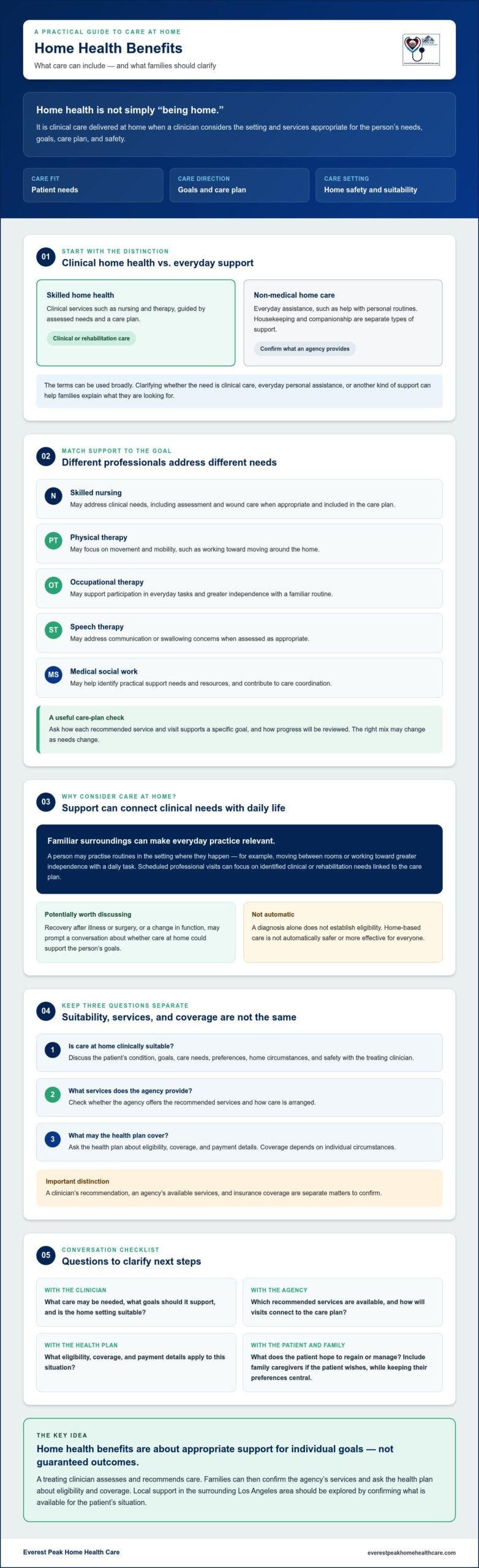
Families often consider recovery needs, comfort, and safety together when deciding where care should take place. Home health is health-related care delivered in a person’s residence when a clinician determines that the setting and services may be appropriate. It can include skilled nursing or therapy, with the type of support guided by the patient’s assessed needs and care plan.
The term can be confusing because home care is also used broadly for help provided at home, including non-medical assistance. Home health refers to clinical services, while everyday personal support may be a separate need. Clarifying the difference can help families explain what they’re looking for to a clinician, agency, or health plan.
Think of home health benefits as support for specific care-plan goals, not guaranteed results. A nurse may address a clinical need, while a therapist may work with a patient on movement, daily tasks, or communication. Whether these services belong at home depends on the individual’s condition, preferences, and home circumstances. A treating clinician should assess the person and recommend suitable care.
How can care at home support recovery and independence?
Familiar surroundings give a person the opportunity to practise everyday routines in the setting where they happen, such as moving between rooms or working toward greater independence with a daily task. Scheduled professional visits can focus on identified clinical or rehabilitation needs, with each visit linked to the care plan. Home-based care isn’t automatically safer or more effective for everyone. The best setting depends on the patient and the support available.
Who might consider home health services?
Someone recovering after an illness or surgery, or experiencing a change in function, may want to ask whether clinical care at home could support their recovery goals. For example, a person who has difficulty with everyday movement after an illness might discuss a therapy assessment with their clinician. A diagnosis alone, however, doesn’t establish eligibility for a service or insurance coverage.
Start by discussing what the patient hopes to regain or manage, what care may be needed, and whether the home setting is suitable. The treating clinician can assess these needs and recommend services. The patient or family can then check which services an agency provides and ask the health plan about coverage. Include family caregivers if the patient wishes, while keeping the patient’s preferences and priorities central.
Which Home Health Services Can Support Different Patient Needs?
Home health services aren’t a one-size-fits-all package. A clinician assesses the patient’s needs, and the care plan should explain how each recommended service supports a particular goal, such as managing a clinical concern or improving an everyday ability. The right mix may change as needs change, so ask what each visit is intended to address and how progress will be reviewed.
Clinical home health is distinct from ongoing household or companionship support. Nursing and therapy involve clinical or rehabilitation services, while personal care assistance may support everyday personal needs. Housekeeping and companionship are separate types of help, so confirm which services an agency actually provides. Medicare’s overview of Medicare home health benefits is one place to check plan-specific service and eligibility information.
What do nursing and therapy visits help address?
Skilled nursing may include assessment and wound care when those services are appropriate and included in the care plan. For more detail about this discipline, see the skilled nursing care guide.
Therapy disciplines address different needs. In-home physical therapy San Fernando Valley residents may consider can focus on movement and mobility in the setting where everyday activity happens, occupational therapy may support participation in daily tasks, and speech therapy may work on communication or swallowing concerns when assessed as appropriate. A care goal might involve moving around the home or completing a familiar task more independently. The treating professional determines which services are suitable and recommends the visit plan. These examples don’t establish what a particular patient needs.
How can social services and personal care contribute?
Medical social workers may help identify practical support needs and resources, and contribute to coordination around a patient’s care. Personal care assistance differs from skilled clinical treatment: it may help with personal routines, while nursing and therapy address clinical or rehabilitation needs. Ask how each recommended support fits the care plan.
Everest Peak Home Health Care offers skilled nursing, physical, occupational, and speech therapy, medical social services, and personal care assistance. If you’re comparing options in the surrounding Los Angeles area, you can learn about local home health services and ask which services may fit the clinician’s recommendations. Confirm coverage and eligibility with the health plan. A service being offered doesn’t by itself mean it’s covered.
Does Home Health Care Guarantee Better Outcomes or Insurance Coverage?
No. Home health benefits aren’t automatic, identical for every patient, or a promise of recovery. Before making plans, separate three questions: Is home-based care clinically appropriate? Does the agency provide the needed service? Will the patient’s health plan cover it under its current rules? A positive answer to one doesn’t guarantee a positive answer to the others.
Service descriptions can help families understand which disciplines might be relevant. For a general overview, Types of home health care services outlines professional care options. The patient’s clinician must assess individual needs, the agency can confirm its services, and the payer determines coverage.
What should families know about Medicare and Medi-Cal?
Medicare, Medi-Cal, and private insurance plans have different requirements, and their guidance may change. Coverage can depend on factors such as medical need, care setting, and program rules. Don’t assume a diagnosis establishes eligibility or that an agency’s service will be paid for by a particular plan. Check current information directly with official Medicare or California Medi-Cal resources, and ask the health plan to confirm the member’s specific benefits.
| Who to ask | Questions to raise |
|---|---|
| Clinician | Is home-based care appropriate for the patient’s current needs? Which services and goals should be included in the recommended plan? |
| Agency | Do you provide each recommended service? What visit plan may be available, and what information is needed to discuss the referral? |
| Payer | Are these specific services covered for this patient under the current plan? Are there conditions, approvals, or cost-sharing details to understand? |
What home health cannot promise
Care at home can support a plan, but it can’t guarantee recovery, greater independence, prevention of complications, or fewer hospital visits. Nor should families assume scheduled home health visits provide round-the-clock supervision. Ask what support is planned between visits and arrange other appropriate help if needed.
Home health is not emergency response. If symptoms are severe or require immediate attention, seek appropriate urgent or emergency care rather than waiting for a scheduled visit. For non-emergency questions about available services in the surrounding Los Angeles area, families can ask about local home health services. Confirm payer participation and coverage directly before relying on them.
How Can Families Decide Whether Home Health Benefits Fit Their Situation?
A clear decision starts with the patient’s priorities, then moves through clinical recommendations, service availability, and payment details. These steps can help families prepare for those conversations and identify what still needs confirmation. Include family caregivers if the patient wishes, while keeping the patient’s preferences central.
- Identify the patient’s goals. Describe what the person hopes to manage, regain, or do more comfortably at home. A specific goal, such as improving mobility for everyday routines, gives the care team a useful starting point.
- Prepare a concise care summary. Record current medications, mobility concerns, recent changes, and any barriers in the home that may affect care. Note questions as they arise so important details aren’t forgotten during appointments.
- Ask the clinician about recommendations. Find out whether care at home is appropriate, which services may support the goals, and what each service is intended to address. For questions about physical therapy, review this in-home physical therapy San Fernando Valley overview.
- Confirm the agency’s plan and availability. Ask which recommended services are offered locally and what the proposed plan includes. Clarify who coordinates visits, how changes in the patient’s condition are communicated, and whom to contact with routine questions.
- Verify benefits and payment details. Contact the health plan or program directly to check current requirements for the specific services. Ask about authorization, patient responsibility, visit limits, and required documentation. Request written clarification if coverage or billing remains uncertain.
Which questions should you ask the clinician and agency?
Focus questions on decisions the clinician and agency can clarify. Ask the clinician which care-plan goals each recommended service supports and how the home setting fits the patient’s needs. Ask the agency which services are available in the patient’s area, what proposed visits involve, who coordinates care, and how routine questions or changes are handled. Write down the answers and any follow-up items.
How should families check benefits and coverage?
Don’t rely on a general description of a plan or an assumption based on a diagnosis. Ask the payer about the patient’s specific benefits, applicable requirements, authorizations, cost responsibility, visit limits, and documentation rules. Keep the date, representative’s name, and reference details from the conversation, and seek written confirmation when possible. These steps help families assess whether home health benefits align with the recommended care and the plan’s terms.
For a local conversation about the services Everest Peak Home Health Care provides in the surrounding Los Angeles area, contact the home health care team. Confirm service availability, eligibility, and coverage separately with the agency and payer.
How Everest Peak Home Health Care Can Help Patients Explore Local Support
For families in and around Los Angeles, checking which services an agency provides is a practical step after discussing care needs with a clinician. Everest Peak Home Health Care is based in North Hollywood and serves the surrounding Los Angeles area. Its team includes nurses, physical, occupational, and speech therapists, and medical social workers. An inquiry can clarify whether a service is offered locally and help answer questions about options. It can’t determine clinical suitability or guarantee eligibility, insurance coverage, or a particular outcome.
What services may be discussed with Everest Peak?
Families can ask about skilled nursing for clinician-recommended nursing needs, or physical, occupational, and speech therapy when those disciplines are being considered. Medical social services may help address practical support and care-coordination questions. Everest Peak also offers personal care assistance, which is distinct from skilled clinical services, and post-operative care. The appropriate services depend on the person’s needs and recommendations, so confirm which options fit the situation.
Be specific about the question you’re trying to resolve. For example, share which service the clinician recommended and ask whether it’s offered for the patient’s location. This makes an initial conversation more useful while leaving clinical decisions to the treating professional and coverage determinations to the payer.
What is a practical next step for Los Angeles families?
Before reaching out, gather clinician recommendations, relevant health-plan or program information, and questions about the patient’s needs. Note which services are being considered and what the family wants to clarify. Ask the agency to confirm its current service-area boundaries, service availability, and scheduling details. Then contact the payer directly about coverage, authorization, and payment responsibilities.
These are separate checks: an agency can explain what it provides and discuss local availability, a clinician assesses care needs, and a health plan explains its current terms. Confirm each detail with the appropriate party rather than assuming a recommendation means a service is available or covered. This helps families explore home health benefits with a clearer understanding of the next steps.
If you’re ready to discuss the patient’s needs and questions about local services, contact Everest Peak to discuss home health care. The care team can clarify service inquiries, while the treating clinician and payer remain the sources for clinical recommendations and coverage decisions.
Take the Next Step Toward Informed Home Care
Home health benefits depend on matching appropriate services to a person’s needs and goals. A clinician can assess whether care at home is suitable, an agency can confirm which services are available, and the health plan can explain coverage and payment requirements. These are separate questions, and checking each one helps families plan with greater clarity.
Everest Peak Home Health Care serves the surrounding Los Angeles area with nursing, physical, occupational, and speech therapy, as well as medical social services and personal care assistance. These offerings may address different needs, but the right fit and coverage must be confirmed for each individual.
To discuss care questions and local service options, contact Everest Peak to discuss home health care. A conversation can help you identify useful next steps.
Frequently Asked Questions
What are the main benefits of home health care?
Home health care may bring appropriate nursing, therapy, or other health-related support into a patient’s residence. Depending on assessed needs and the care plan, these home health benefits may support recovery goals, daily function, or care coordination. Services and results vary from person to person, and care at home doesn’t guarantee a particular outcome. A clinician can assess whether the setting and recommended services fit the patient’s condition and circumstances.
Who qualifies for home health care?
Eligibility depends on the service being considered, the person’s clinical needs, the care plan, and the rules of the relevant payer or program. Having a health condition or preferring care at home doesn’t automatically establish eligibility. Ask the treating clinician to assess the patient’s needs, then confirm current requirements with the health plan or program. An agency can clarify which services it provides in the patient’s area, but it can’t determine payer eligibility.
Does Medicare pay for home health care?
Medicare may cover eligible home health services, but coverage depends on current program requirements and the patient’s circumstances. Don’t assume every service or situation qualifies. Ask the clinician and Medicare plan or program administrator which services may be covered, what documentation or authorization is needed, and whether the agency participates. Confirm details directly before care begins, including any patient responsibility, because coverage can depend on the specific plan and circumstances.
Is home health care the same as home care?
Not necessarily. Home health commonly refers to health-related services such as skilled nursing or therapy, while “home care” may describe assistance with daily activities or companionship. The terms can be used broadly, and service definitions and payer rules vary. Ask the agency to specify the professional involved, the service being proposed, its purpose, and how payment works. This helps distinguish clinical care from non-medical support before making arrangements.
Can home health care help someone recover after surgery?
It may support parts of a post-operative care plan when the treating clinician considers home-based services appropriate. Nursing or rehabilitation may address specific needs identified in the plan, but home health doesn’t guarantee faster recovery or prevent complications. Follow the surgeon’s instructions and ask which services are recommended for the patient. If symptoms arise that the care team identifies as an emergency, seek urgent medical help rather than waiting for a scheduled visit.
How often do home health professionals visit?
Visit frequency depends on the patient’s assessed needs, the recommended care plan, professional availability, and applicable payer requirements. Visits aren’t necessarily daily, and home health doesn’t automatically provide continuous supervision. Ask the clinician who recommends the plan and the agency who determines the schedule, how changes are communicated, and whom to contact between visits. Confirm the expected visit plan directly instead of assuming a particular frequency or level of support.
What is the difference between home health care and 24-hour care?
Home health care generally involves scheduled visits for defined clinical or supportive needs. It doesn’t automatically mean someone is present continuously. Round-the-clock or live-in care is a separate arrangement, and families should ask providers what they offer if additional support is needed between visits. Everest Peak Home Health Care doesn’t offer 24/7 live-in care. Discuss supervision needs with the treating clinician and confirm appropriate arrangements directly with providers.