

The right care choice depends on the goal, and that goal can change over time. If you’re weighing home health care vs hospice, it’s understandable to feel uncertain about whether the priority is recovery, relief from difficult symptoms, or support near the end of life.
These care models serve different purposes, and eligibility, services, and insurance coverage can vary. This article explains how home health care, palliative care, and hospice differ, what each is designed to provide, and where each may fit in a person’s care plan. You’ll also find practical questions to ask a physician, health plan, or care provider before making decisions.
Choosing one option now doesn’t necessarily rule out another later. Needs and eligibility may change, so ask how care can be reviewed and coordinated over time. Clear answers can help you and your family identify an appropriate next step without pressure or assumptions.
Key Takeaways
- Compare home health care vs hospice by the care goal: recovery, symptom relief, or end-of-life support.
- Use the care-team and service comparison to identify what to verify for the individual’s needs, provider, and coverage.
- Ask the care team which treatments may continue under a proposed hospice plan rather than assuming hospice means giving up all treatment.
- Bring focused questions to your California care team, and include the patient’s preferences and family circumstances in planning.
- When in-home nursing or rehabilitation may be appropriate, explore available home health services. Everest Peak provides home health care, not hospice or 24/7 live-in care.
Home Health vs. Hospice: Goals of Each Care Type
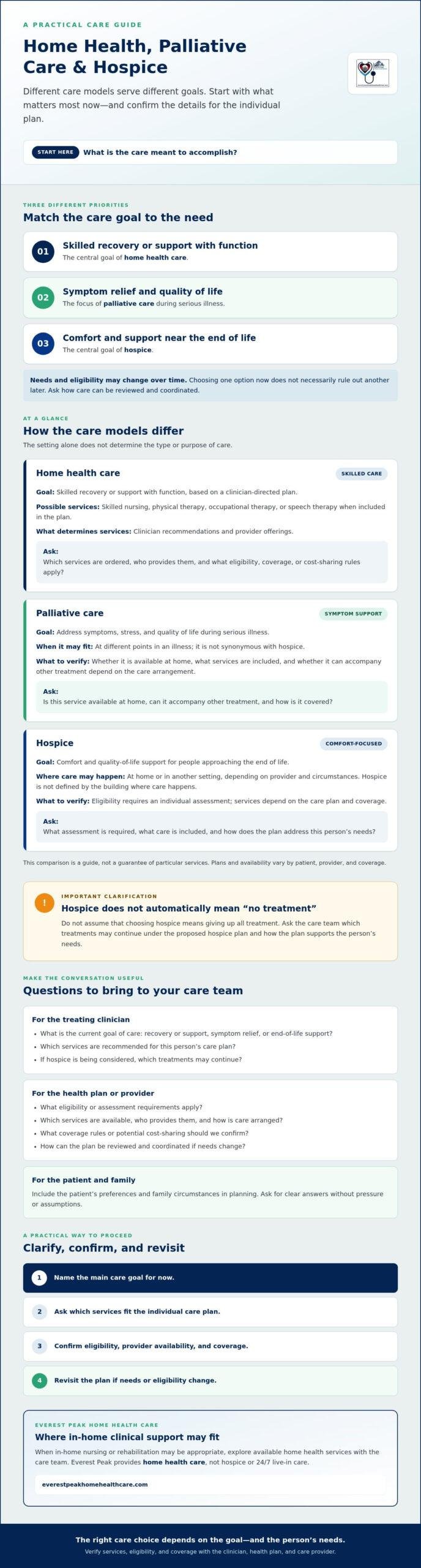
These services have different purposes, and a person’s needs can change over time. Comparing home health care vs hospice starts with the question of what care is meant to accomplish: skilled recovery or support, symptom relief, or end-of-life care. A conversation with the treating clinician can help clarify the current goal without assuming that one choice must apply indefinitely.
Home health care generally refers to clinician-directed services provided at home as part of an individual care plan. When appropriate, the plan may include skilled nursing or rehabilitation, such as physical, occupational, or speech therapy. The clinician’s recommendations and the provider’s offerings determine which services are available. Eligibility and coverage depend on the person’s circumstances and health plan, so confirm current requirements and any potential cost-sharing with the plan and provider.
Hospice centers on comfort and quality of life for people approaching the end of life. It isn’t defined by the building where care happens. Depending on the provider and circumstances, hospice may be arranged in a person’s home or another setting. Eligibility requires an individual assessment, and services can vary by care plan and coverage. For background on the philosophy and practice of hospice care, readers can review this overview, then discuss personal eligibility and options with their care team.
How does home health care differ from hospice?
Home health care focuses on skilled recovery or maintaining function when clinical care at home is appropriate. Hospice focuses on end-of-life support, with comfort as a central goal. The specific services in either model depend on the individual plan, provider, and coverage, not just the name of the service.
Home health is organized around skilled care and recovery or function; hospice is organized around comfort and support near the end of life.
Where does palliative care at home fit?
Palliative care addresses symptoms, stress, and quality of life during serious illness. It isn’t synonymous with hospice and may be considered at different points in an illness. Whether it can be provided at home, what services are included, and whether it can accompany other treatment depend on the care arrangement. Ask the clinician and provider what is available and verify coverage. Not every home health agency offers a dedicated palliative care program.
For example, someone who needs clinician-directed rehabilitation at home can ask whether home health services fit the care plan. A family seeking hospice or palliative support should ask separately which providers offer those services, what assessment is required, and how the plan coordinates with existing treatment.
Compare Home Health, Home Palliative Care, and Hospice by Goals and Services
Care labels can be confusing because different types of support may take place at home. Use this comparison to ask about the purpose of care, who may provide it, and what needs confirmation. The setting alone doesn’t determine the type or purpose of care.
Home health
Goal: Skilled recovery or support with function, based on a clinician-directed plan.
Possible team or services: Nursing, physical therapy, occupational therapy, or speech therapy, when included in the plan.
Ask: Which services are ordered, who provides them, and what eligibility and coverage rules apply?
Home palliative care
Goal: Relief of symptoms and support for quality of life during serious illness.
Possible team or services: Clinicians involved in symptom support and care planning; the team and services depend on the arrangement.
Ask: Is this service available at home, can it accompany other treatment, and how is it covered?
Hospice
Goal: Comfort and quality-of-life support near the end of life.
Possible team or services: The hospice provider can explain its team, services, and how care is arranged.
Ask: What assessment is required, what care is included, and how does the plan address this person’s needs?
This is a guide, not a guarantee of particular services. Treatment plans and availability vary by patient, provider, and coverage. The National Institute on Aging explains the relationship between palliative care and hospice care; discuss how those distinctions apply to an individual situation with the care team.
Which professionals may be involved?
Depending on the care plan, home health may involve nurses, therapists, or medical social workers. Confirm the hospice team’s composition and included services directly with the hospice provider. To understand what nursing care at home may involve, see this guide to skilled nursing care at home.
Which services should families ask about?
Ask who will visit, what each professional will do, and how visit schedules are determined. Clarify whether ongoing help with personal tasks is available and who provides it. Personal care assistance is distinct from skilled nursing and hospice services; it doesn’t replace clinical treatment. Medical social services may help with practical care planning, but availability depends on the provider and plan.
Families in North Hollywood and surrounding Los Angeles communities can ask Everest Peak Home Health Care whether its skilled nursing, rehabilitation therapies, or medical social services may fit their needs and service area. Everest Peak provides home health services, not hospice or 24/7 live-in care.
Does Choosing Hospice Mean Giving Up Treatment? Common Questions and Misconceptions
No. Choosing hospice doesn’t mean a person is abandoned or that every form of treatment stops. It means the care plan is centered on comfort and quality of life near the end of life. Which treatments remain part of that plan depends on the person’s needs, the hospice provider’s arrangements, and applicable coverage rules. Families deserve clear answers before making decisions.
The difference between home health care vs hospice is about care goals, not how much a person or family cares. A hospice discussion can cover what the patient hopes to prioritize, which symptoms need attention, and how the team will support the family. Palliative care also focuses on symptom relief and quality of life, but it isn’t the same as meeting hospice eligibility requirements. Ask the treating clinician to explain which options may fit and why.
Can comfort-focused care include treatment?
It may. Depending on the individual plan, symptom relief can be part of care alongside other treatment. Direct questions about hospice, including whether a proposed treatment is included or covered, to both the hospice provider and treating clinician. Ask how the treatment relates to the patient’s goals and what costs or coverage conditions may apply. A general description can’t predict an individual outcome.
Can care needs or preferences change over time?
Yes. If symptoms, function, or a patient’s wishes change, revisit goals with the treating clinician. A change in needs doesn’t automatically switch someone from one model to another. Any transition depends on clinical assessment, provider availability, and applicable eligibility and coverage rules. Ask what steps would be needed and who to contact if circumstances change.
These clarifications can help separate common fears from questions that need an individual answer:
- Misconception: Hospice means no treatment. Clarification: The plan focuses on comfort; ask the hospice provider and clinician which treatments may continue and verify coverage.
- Misconception: Palliative care automatically means hospice. Clarification: Palliative support addresses symptoms and quality of life, while hospice has its own eligibility and care requirements. Confirm the applicable criteria.
- Misconception: Choosing a care model locks in the decision. Clarification: Needs and preferences can be discussed again, but a transition requires review and confirmation of provider options and coverage.
For each question, request an explanation specific to the patient’s circumstances and plan. Coverage details can change and differ by payer, so verify current rules directly with the health plan and care provider before relying on them.
How to Decide: Questions for Your California Care Team
A useful decision conversation separates clinical recommendations from coverage and provider availability. Involve the patient whenever possible, and include their preferences and family circumstances in planning. If the patient can’t speak for themselves, ask the care team how their known wishes can guide decisions.
Use these steps to organize a discussion about home health care vs hospice and other possible support:
- 1. Clarify the goal. Ask the treating clinician what the plan is intended to address now: recovery, maintaining function, symptom relief, or end-of-life support. Ask what changes might prompt a review of that goal.
- 2. Describe clinical needs. Share current symptoms, recent changes, treatment needs, mobility concerns, and the kinds of help required at home. Ask which services are appropriate and who will coordinate the plan.
- 3. Verify eligibility and coverage. Contact the health plan separately to ask how eligibility, authorizations, network rules, and patient costs are determined. Verify current Medicare, Medi-Cal, or other coverage details with the relevant organization, and ask the provider what requirements need confirmation.
- 4. Plan the next step. Confirm who will follow up, what information or referral is needed, and when the care team will review the plan. A change in goals is a reason to talk, not an automatic switch between services.
What should you ask a home care agency?
Ask which disciplines it provides, whether the patient’s address is within its service area, what visit availability can be confirmed, and whether a referral or other documentation is needed. Be specific about the service under consideration. Don’t assume a home health agency offers palliative care or hospice; confirm that directly with the provider. For a recovery-related example, see this overview of post-operative care at home.
California families should verify coverage and eligibility with the patient’s particular health plan and ask providers which services they can deliver in the relevant location. Avoid relying on general statements about benefits or availability; request current, individual confirmation.
For people in North Hollywood and surrounding Los Angeles communities exploring in-home skilled nursing, rehabilitation therapies, or medical social services, ask Everest Peak about home health services and service-area fit. The agency provides home health services, not hospice care.
When In-Home Clinical Support May Help, and How to Explore Next Steps
After comparing home health care vs hospice, consider whether the current care plan includes clinical needs that may be addressed at home. A clinician may recommend skilled nursing or rehabilitation as part of recovery or support with function. That recommendation alone doesn’t confirm eligibility, coverage, provider availability, or a particular schedule. Discuss the plan with the treating clinician and verify details with the health plan and agency.
Could home health care support a recovery plan?
In-home skilled nursing or rehabilitation may be worth discussing when a clinician believes services at home are appropriate. Depending on the care plan and provider, options to ask about may include nursing, physical therapy, occupational therapy, or speech therapy. These services aren’t guaranteed for every patient and don’t promise a particular recovery outcome. Discuss clinical needs with the treating clinician and care team.
Everest Peak Home Health Care provides home health services, including skilled nursing, rehabilitation therapies, medical social services, and personal care assistance. It does not provide hospice or 24/7 live-in care. Personal care assistance is separate from skilled clinical treatment, so ask which type of support addresses the need you’re discussing.
How can a family make a respectful first inquiry?
Prepare the clinician’s recommendation, the patient’s location, the services being considered, and any relevant timing or care questions. Where possible, include the patient in the discussion and explain preferences or family circumstances that may affect planning.
Ask the agency which services may match the clinician’s recommendation, whether the location is within its service area, and what referral information or availability can be confirmed. Confirm current eligibility and coverage separately with the health plan. Don’t assume that a service is covered or that a referral assures a specific start date.
For North Hollywood and surrounding Los Angeles communities, families can ask Everest Peak whether its in-home services and service area fit their needs. A conversation can help clarify the next question to take back to the clinician or health plan, without requiring assumptions about which care model is right.
Contact Everest Peak Home Health Care to discuss in-home services.
Take the Next Step With Clearer Care Goals
The key distinction in home health care vs hospice is the purpose of care: home health may support skilled recovery or function, while hospice focuses on comfort near the end of life. Palliative care supports symptom relief and quality of life, and isn’t automatically the same as hospice. The appropriate option depends on a person’s needs, preferences, and clinical assessment.
Before deciding, ask the treating clinician what care goal is appropriate now, then confirm services, eligibility, and coverage with the health plan and provider. Needs and preferences can change, so keep the conversation open and include the patient whenever possible.
For families in North Hollywood and surrounding Los Angeles communities, Everest Peak Home Health Care provides home health services that include skilled nursing and rehabilitation therapies. Its team includes licensed registered nurses and vocational nurses, as well as rehabilitation therapists. Everest Peak doesn’t provide hospice care or 24/7 live-in care.
Contact Everest Peak Home Health Care to discuss in-home services and ask whether its services and service area may fit your needs. A clear, unhurried conversation can help you identify a thoughtful next step.
Frequently Asked Questions
What is the difference between home health care and hospice?
Home health care generally provides clinician-directed services at home to support recovery or function, while hospice focuses on comfort and quality of life near the end of life. The difference in home health care vs hospice is primarily the goal of care, not the location. Services depend on the individual care plan, provider, clinical assessment, and coverage, so confirm details with the treating clinician and health plan.
Can you receive palliative care at home without being in hospice?
Yes, palliative care may be available at home without hospice, but availability and eligibility depend on the care arrangement and provider. Palliative care focuses on symptoms and quality of life during serious illness; it isn’t automatically the same as hospice. Ask the treating clinician about options, then confirm which providers offer home-based palliative care and whether the service can accompany other treatment under the applicable coverage.
Does choosing hospice mean stopping all treatment?
No, choosing hospice doesn’t necessarily mean stopping every treatment. The care plan is centered on comfort, and which treatments may continue depends on the individual’s goals and hospice arrangements. Ask the hospice provider and treating clinician how a specific treatment fits the plan and whether it’s covered. Don’t assume every treatment is included or excluded based on a general explanation; verify current rules with the provider and health plan.
Can a person receive home health care and hospice at the same time?
It depends on the services, the reason they’re needed, the care arrangements, and applicable coverage rules. Don’t assume separate home health services can be added to hospice or covered at the same time. Ask the hospice provider which services are coordinated through its plan, then check with the home health agency and health plan about any additional care. Request confirmation for the specific situation before arranging services.
Who determines whether someone qualifies for home health care or hospice in California?
Eligibility depends on clinical assessment and the requirements of the relevant provider and health plan. A treating clinician can explain which care goals and services may be appropriate; a home health or hospice provider can describe its assessment and referral process. In California, verify current criteria with the provider and payer rather than relying on general descriptions. Ask each organization who makes the decision and what documentation is needed.
Does Medicare or Medi-Cal cover home health care, palliative care, or hospice?
Coverage varies by program, individual eligibility, service, and care arrangement. Don’t assume Medicare or Medi-Cal coverage based only on a service name or clinician’s recommendation. Contact the relevant plan or program to confirm current criteria, authorizations, network requirements, and any patient responsibility. Identify the services being considered when you ask the provider or payer, so the answer applies to the patient and plan.
Can a patient change from home health care to hospice later?
A patient may be able to consider hospice later if needs and goals change, but a transition isn’t automatic. Discuss the change with the treating clinician, who can explain whether a new assessment is appropriate. Then speak with a hospice provider and health plan to confirm eligibility, availability, and coverage. In California, the patient’s preferences and circumstances should guide this conversation alongside current clinical information and applicable program rules.