

What if the greatest obstacle to your loved one’s healing isn’t their medical diagnosis, but the unaddressed emotional and logistical strain at home? When a family member returns from the hospital, managing complex physician orders alongside mounting insurance paperwork can quickly lead to caregiver exhaustion. You want the highest standard of recovery for your loved one, yet balancing domestic safety with sudden healthcare demands often feels overwhelming. That’s why medical social services home health professionals serve as an essential bridge, addressing the personal and practical challenges that clinical treatments alone cannot resolve.
In this guide, you’ll discover how medical social services in home health resolve emotional, financial, and logistical barriers to support patient recovery. We examine the exact scope of licensed clinical visits, clarify qualification criteria under Medicare and private plans, and explain how to secure local community resources and advance directives to restore lasting peace of mind for your entire family.
Key Takeaways
- Learn how medical social services home health clinicians evaluate emotional, logistical, and financial obstacles to remove hidden barriers to recovery.
- Discover what licensed medical social workers do during in-home visits, from comprehensive environmental assessments to short-term counseling and coping strategies.
- Understand Medicare qualification requirements, including homebound status rules and why social work operates as a dependent clinical service alongside skilled care.
- Explore how multidisciplinary collaboration between social workers, skilled nurses, and physical therapists directly reduces preventable hospital readmissions.
- Find practical guidance for families across Greater Los Angeles to access local community programs, advance care planning, and coordinated domestic support.
What Are Medical Social Services in Home Health Care?
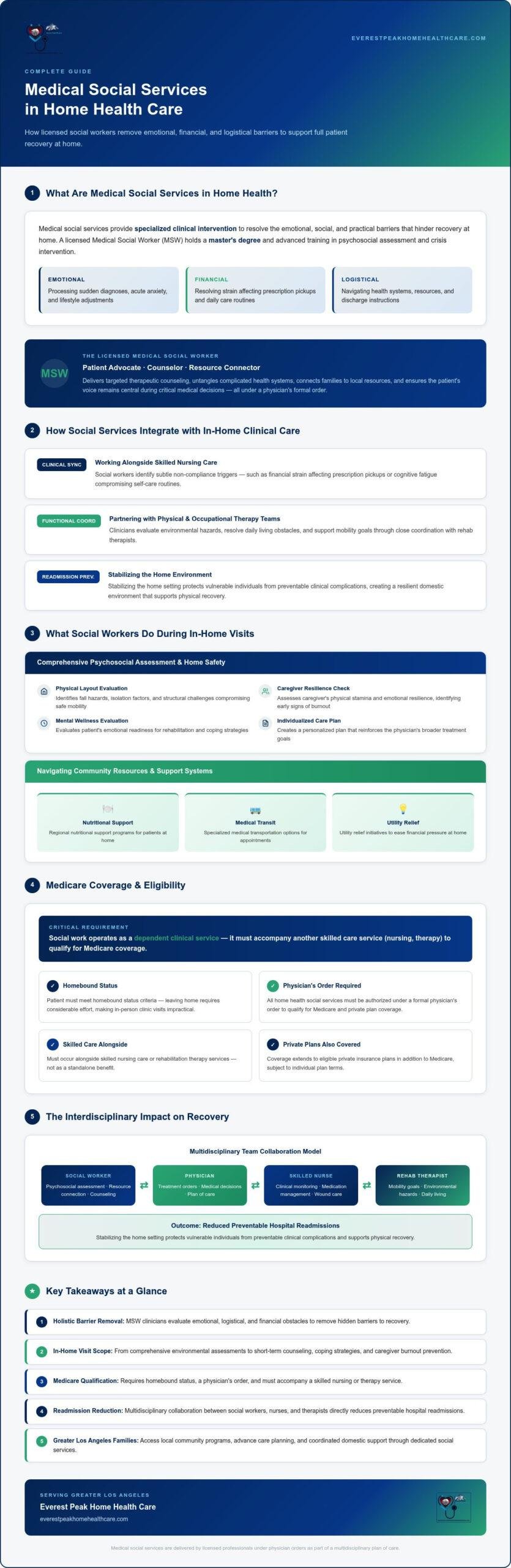
Within modern post-acute recovery, medical social services home health teams provide specialized clinical intervention designed to resolve the emotional, social, and practical barriers that hinder recovery. While physical recuperation relies on skilled clinical care, an individual’s domestic environment often presents hidden challenges that impede progress. Licensed professionals assess interpersonal dynamics, home safety, and practical resource needs under a physician’s formal order. By addressing these non-medical obstacles directly, individualized care plans ensure that medical treatments translate into sustained, long-term health improvements.
The Clinical Role of a Licensed Medical Social Worker (MSW)
A licensed Medical Social Worker (MSW) holds a master’s degree from an accredited institution and possesses advanced training in psychosocial assessment and crisis intervention. Rather than performing basic clerical tasks, an MSW delivers targeted therapeutic counseling to help individuals process sudden diagnoses, acute anxiety, and lifestyle adjustments. Through the specialized discipline of medical social work, these clinicians serve as dedicated patient advocates. They untangle complicated health systems, connect families to essential local resources, and ensure the patient’s voice remains central during critical medical decisions.
How Social Services Integrate with In-Home Clinical Care
Optimal healing occurs when medical treatments and domestic stability work in unison. Within a multidisciplinary plan of care, social workers collaborate directly with attending physicians, visiting nurses, and rehabilitation therapists to maintain overall patient safety:
- Clinical synchronization: Working alongside skilled nursing care, social workers identify subtle non-compliance triggers, such as financial strain affecting prescription pickups or cognitive fatigue compromising self-care routines.
- Functional coordination: Partnering with physical and occupational therapy teams allows clinicians to evaluate environmental hazards, resolve daily living obstacles, and support mobility goals.
- Readmission prevention: Stabilizing the home setting protects vulnerable individuals from preventable clinical complications, creating a resilient domestic environment that supports physical recovery.
By eliminating emotional distress and practical roadblocks, medical social services home health specialists empower patients to focus their energy entirely on rehabilitation and personal well-being.
What Medical Social Workers Do During In-Home Visits
During an initial consultation, a licensed clinician steps into the household to observe the daily realities of an individual’s recovery. Delivering medical social services home health visits involves much more than reviewing medical records; it requires an attentive evaluation of the emotional, environmental, and practical circumstances shaping the patient’s home life. By understanding these subtle domestic realities, clinicians turn complex discharge instructions into manageable daily routines.
Comprehensive Psychosocial Assessments and Home Safety
Every recovery journey begins with a detailed psychosocial evaluation. The visiting social worker evaluates the physical layout of the residence to identify fall hazards, isolation factors, and structural challenges that might compromise safe mobility. Simultaneously, the clinician assesses the primary caregiver’s physical stamina and emotional resilience, identifying early signs of burnout before informal support falters. By evaluating the patient’s mental wellness and emotional readiness for rehabilitation, the social worker creates an individualized plan that reinforces the physician’s broader treatment goals.
Navigating Community Resources and Support Systems
Connecting patients with external community programs resolves practical obstacles that often disrupt recuperation. Social workers guide families through regional nutritional support programs, specialized medical transit options, and utility relief initiatives. When daily recovery demands extra hands-on help with bathing or meal preparation, the clinician coordinates smooth transitions toward ongoing personal care assistance in North Hollywood to protect domestic stability. Official regulations for Medicare home health services coverage require these community connections to tie directly to the patient’s medical recovery, ensuring every referral serves a therapeutic purpose.
Facilitating Advance Directives and Long-Term Care Planning
Proactive care planning offers emotional relief during uncertain medical events. Social workers facilitate sensitive family discussions regarding healthcare values, proxy decision-makers, and future medical preferences. They assist families with completing durable power of attorney for healthcare forms and living wills, clarifying standard documentation without offering legal advice. Families seeking compassionate guidance during critical care transitions can turn to Everest Peak Home Health Care to establish a supportive, coordinated path forward.
Medicare Coverage and Eligibility for Home Health Social Services
Qualifying for in-home supportive care requires meeting specific federal standards. Under Medicare Part A and Part B, medical social services home health visits are fully covered clinical benefits, but they are categorized as dependent services. This means a patient cannot establish eligibility based on psychosocial needs alone. Instead, clinical guidelines established by Medicare and mirrored by most private commercial insurers require a primary medical necessity, verified by an attending physician’s formal order and certification. Families who want a thorough overview of what coverage may include can review home health benefits and what patients and families should know before beginning the intake process.
The Qualifying Skilled Clinical Need Requirement
To access medical social work, a patient must first demonstrate an intermittent need for skilled nursing care, speech therapy, or physical rehabilitation. For instance, pairing a clinical social worker with in-home physical therapy enables the care team to address mobility challenges alongside domestic safety risks. Occupational therapy can also sustain social work coverage once an initial qualifying service begins. When reviewing the broad types of home health care services available to recuperating adults, social work consistently serves as a vital secondary discipline that resolves social determinants of health while medical clinicians treat the underlying diagnosis.
Understanding Homebound Status Criteria
Federal regulations mandate that an individual must meet homebound status criteria to receive covered home health services. Meeting this definition does not mean a person is completely bedridden, but it does require that leaving home involves significant physical difficulty:
- Taxing effort: The patient must experience a normal inability to leave the residence, where any excursion requires a considerable and taxing effort due to severe weakness, cognitive decline, or pain.
- Supportive assistance: Leaving the home typically requires specialized mobility devices like walkers, wheelchairs, or crutches, or direct physical assistance from another caregiver.
- Permitted absences: Homebound individuals can still attend outpatient medical appointments, licensed adult day health programs, and infrequent, short-duration events such as religious services or unique family gatherings without losing coverage.
When an attending physician certifies these clinical criteria, medical social services home health teams can enter the home to stabilize care routines and protect patient recovery.
The Interdisciplinary Impact: How Social Services Accelerate Recovery
Clinical treatments often fail when practical domestic struggles go unnoticed. A patient may receive precise nursing care and physical therapy, yet missed medication schedules or poor nutrition can quickly undo that progress. Multidisciplinary studies published in post-acute care journals show that incorporating medical social work and social-determinants-of-health assessments into transitional care reduces 30-day hospital readmissions by 20% to 30%. By identifying the invisible hurdles to compliance, medical social services home health clinicians ensure that every member of the care team works toward lasting recuperation.
Mitigating Caregiver Burnout with Practical Strategies
Family caregivers carry immense physical and psychological strain during post-hospital transitions. According to research from the AARP Public Policy Institute and the National Alliance for Caregiving, more than 53 million Americans provide unpaid care, with over half reporting significant emotional stress that jeopardizes home recovery. Visiting social workers evaluate caregiver fatigue before exhaustion leads to a complete breakdown in domestic support. Clinicians introduce sustainable pacing methods, locate regional respite relief grants, and connect relatives to local caregiver peer groups to preserve informal care networks.
Resolving Socioeconomic Barriers to Medical Adherence
When financial worries or limited transportation compromise a recovery plan, medical social workers intervene with concrete solutions:
- Medication accessibility: Clinicians review pharmaceutical patient assistance programs, locate pharmacy delivery options, and address budget shortfalls that cause skipped doses.
- Nutritional security: Evaluating food access ensures patients receive medically tailored meals that support wound healing and energy balance.
- Follow-up coordination: Arranging non-emergency transit programs guarantees that individuals attend essential follow-up consultations with primary physicians.
Crisis Intervention and Sudden Health Transitions
Unexpected clinical declines can trigger panic within a household. When a chronic disease suddenly worsens, social workers provide steady emotional de-escalation, helping families process medical updates with clarity. If a temporary hospital readmission becomes unavoidable, the clinician coordinates with inpatient staff to facilitate a smoother return home. Discover how whole-person care elevates recovery outcomes by reviewing the multidisciplinary clinical options available through Everest Peak Home Health Care.
Accessing Dedicated Medical Social Services with Everest Peak Home Health Care
Securing comprehensive in-home support begins with an organized, responsive intake process. At Everest Peak Home Health Care, clinical coordinators work alongside attending physicians and hospital discharge planners across North Hollywood, the San Fernando Valley, and Greater Los Angeles to establish physician-directed care plans. Because medical social services home health interventions require a primary skilled clinical service, our intake team coordinates immediately with visiting registered nurses and physical therapists to obtain the required physician orders, ensuring that every family experiences a seamless transition from hospital to home.
Personalized Support for Los Angeles and San Fernando Valley Families
Southern California families face distinct challenges when coordinating post-acute care, from navigating crowded regional healthcare systems to identifying neighborhood-specific support networks. Everest Peak Home Health Care tailors every plan to the patient’s cultural background, personal values, and domestic routine. Our clinicians coordinate seamlessly with our licensed medical social worker home visits in Los Angeles team, connecting households directly to Los Angeles County Area Agencies on Aging, local senior meal initiatives, and regional non-profit programs designed to preserve independence. Families who also need movement rehabilitation can learn more about in-home physical therapy in the San Fernando Valley to understand how coordinated clinical services support recovery across every dimension of daily life.
What to Expect During Your Initial In-Home Consultation
The initial consultation takes place directly in the patient’s residence as a supportive, conversational assessment rather than a clinical audit. A licensed social worker sits down with the patient and family to discuss current recovery goals, identify daily practical worries, and outline viable solutions. Having certain documents accessible helps the clinician establish support rapidly:
- Healthcare records: Recent hospital discharge paperwork, a current list of prescribed medications, and attending physician contact details.
- Insurance documentation: Primary Medicare cards and supplemental commercial insurance policies to verify clinical coverage boundaries.
- Existing advance directives: Copies of current durable power of attorney forms, living wills, or POLST forms if already completed.
Every interaction prioritizes dignity, strict patient confidentiality, and personal autonomy. By evaluating the full domestic picture, medical social services home health professionals empower individuals to regain physical strength while restoring stability and lasting confidence within the household.
Empowering Your Family’s Path to Lasting In-Home Recovery
Sustainable recovery requires addressing both clinical symptoms and the practical realities of daily life. By resolving environmental hazards, caregiver exhaustion, and community resource gaps, medical social services home health teams build the domestic foundation necessary for physical rehabilitation to succeed. When emotional burdens lift and logistical barriers disappear, patients can direct their full energy toward healing in the comfort of home.
As a locally owned agency proudly serving North Hollywood and the greater Los Angeles community, our multidisciplinary clinical team integrates skilled nursing, physical therapy, and social services into one unified recovery plan. Our licensed Master of Social Work (MSW) clinicians collaborate directly with attending physicians to protect patient autonomy, restore peace of mind, and prevent avoidable hospital readmissions. Connect with our clinical team at Everest Peak Home Health Care to discuss comprehensive in-home support for your family, and let our dedicated team help you navigate every stage of recovery with confidence.
Frequently Asked Questions
What is the primary role of medical social services in home health?
The primary role of medical social services home health clinicians is to resolve the social, emotional, and environmental obstacles that hinder an individual’s recovery at home. Licensed medical social workers evaluate domestic safety, deliver supportive short-term counseling for coping with illness, and connect families to community welfare programs. In California, these specialists serve as essential patient advocates who ensure the home environment remains stable while clinical therapies take place.
Does Medicare cover medical social services for homebound patients?
Yes, Medicare Part A and Part B cover medical social services when an eligible patient meets statutory homebound criteria and receives care from a Medicare-certified agency. The patient must require intermittent skilled nursing, physical therapy, or speech-language pathology under an active physician-certified plan of care. When social or emotional factors directly impede medical recovery, Medicare covers visits from a licensed clinician as part of the overall clinical plan.
Can a medical social worker visit my home without a doctor’s order?
No, licensed clinical home health social workers cannot provide covered visits without a signed order from an attending physician or authorized healthcare provider. In-home health care operates strictly under physician-directed care plans. When a doctor identifies emotional distress, caregiver strain, or environmental safety issues during an assessment, they issue a clinical order that allows our multidisciplinary team to schedule and conduct in-home psychosocial evaluations.
Can medical social services be ordered on their own without nursing or therapy?
Medical social services cannot be initiated as a standalone home health discipline under Medicare and standard commercial insurance guidelines. Federal regulations classify social work as a dependent service. To qualify, a patient must first demonstrate an intermittent clinical need for skilled nursing care, physical therapy, or speech therapy. Once skilled care is active, a social worker can be added to address recovery barriers and long-term domestic planning.
How does a medical social worker help prevent hospital readmissions?
Medical social workers reduce avoidable hospital readmissions by identifying and eliminating hidden domestic breakdowns before they cause clinical complications. They evaluate why a patient might skip prescriptions, whether due to cognitive difficulties, transportation hurdles, or economic stress. By coordinating pharmacy drop-offs, establishing follow-up physician transit, and reinforcing home safety, these clinicians build a stable setting that prevents sudden health deterioration and emergency department visits.
What is the difference between a medical social worker and a case manager?
While both roles coordinate support, a medical social worker provides clinical psychosocial therapy, whereas a case manager primarily handles insurance authorizations and administrative logistics. Medical social workers hold advanced master’s degrees enabling them to conduct crisis intervention, emotional counseling, and advance care planning directly in the residence. Case managers typically focus on tracking coverage benefits, utilization metrics, and overall service authorizations across administrative systems.
How do medical social workers assist family caregivers experiencing burnout?
Medical social workers support exhausted family caregivers by providing practical coping strategies, stress-management counseling, and connections to local relief programs. When delivering medical social services home health support across Los Angeles County, social workers introduce sustainable caregiving schedules and coordinate local respite services or adult day care options. They also guide families toward supportive care options like personal care assistance to alleviate physical burdens before informal care networks collapse.